
Think again

Children with Down syndrome can become multilingual

By Dawn Morrison - July 12, 2007

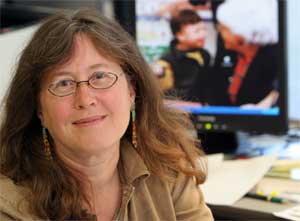
Dr. Elizabeth Kay Raining Bird
"These children can do very well in acquiring two languages," says Dr. Elizabeth Kay-Raining Bird. (Pearce photo)

The language abilities of children with Down syndrome may exceed the expectations of professionals who work with them on a regular basis, according to a new study based at Dalhousie.

These children have traditionally been discouraged from becoming bilingual by some speech language pathologists and other professionals due to perceived difficulties, says Dr. Elizabeth Kay-Raining Bird. The reality, according to her teamÕs findings, does not support this practice.

ÒParents of special needs children including those with Down syndrome are frequently counseled away from bilingualism without the benefit of research to show how capable they actually can be. Ours is the first group study that documented that children with Down syndrome can become bilingual. There is no evidence in our study to suggest input should be restricted to a single language. In fact, these children can do very well in acquiring two languages.”

The preliminary results of this study have enormous implications for children with Down syndrome and their families, and the professionals who work with them.

Quick facts

- The occurrence of Down syndrome is universal, and it is estimated to be present in approximately one in 800 births in Canada.
- The sole characteristic shared by all persons with Down syndrome is the presence of extra genetic material associated with the 21st chromosome. The effects of that extra genetic material vary greatly from individual to individual. From: The Canadian Down Syndrome Society (CDSS)
- In most cases, Down syndrome is accompanied by an intellectual disability and particular difficulty learning language. In general, it is harder for these individuals to learn to use language than to understand language.

ÒRather than restricting input to one language, it seems important for speech-language pathologists to provide appropriate supports in both languages that a child needs to learn so as to ensure that they acquire each language to the best of their ability.”

Dr. Kay-Raining BirdÕs research is just one of 11 projects at Dalhousie University to receive new federal funding from The Social Sciences and Humanities Research Council of Canada (SSHRC). The recipients of the SSHRC Standard Research Grants program were recently announced, with an investment of $77.8 million supporting 2,800 projects across Canada.

Dr. Kay-Raining Bird and her co-investigators Patricia Cleave of Dalhousie University and Natacha Trudeau and Ann Sutton from the University of Montreal received $101,002 in funding for ongoing study into The Language Abilities of Bilingual Children with Down Syndrome. Dr. Kay-Raining Bird is a professor at Dalhousie and a speech-language pathologist. Her research interest areas include child language and literacy development and disorders, with a particular focus upon Down syndrome and autism.

This latest round of funding allows Dr. Kay-Raining BirdÕs team to continue with this multi-year project for an additional three years. By the end of the grant, they will have examined the same set of children for six years. Their research over the years has examined whether children with Down Syndrome can become bilingual and to what extent, and also whether bilingualism has affected their developmental trajectory.

Readers Say

I just came across your article online. My three year old with Down Sydnrome is multi-lingual. He first learned Croatian due to being around his grandparents and listening to Croatian music. He is now picking up lots of English due to DVDs and pre-school. He still loves Croatian music and sings along to both contemporary Croatian and English artists at home and in the car. It is amazing. He is also comprehending words in both languages. He can string together 5 and six-word sentences in both languages. He seems to know when to say one or the other too. Because at pre school he speaks English and at home it is both. He has really surprised me with his language skills.
In Germany there is the problem (our daughter Johanna is born 13.11.06) of not being integrated in standard school system (I think of standard examine control and regular certificates ). They have the category of "integrated classes" that means, that Down children can stay together with regulars but will be qualified in a separated dimension. With your results it can be proved, that Down-children can take part in the regular school system because one of the steps to come through is the second language. I hope you can pass the results of your studies to me and perhaps give some hints how we can improve the abilities of our daughter already in her young age. I hope to hear from you, Josef Stührenberg and his family
This article is very exciting for me. My three year old is just about to start in a bilingual pre-school in early September. The primary language in the pre-school will be Irish. Our primary language at home is English. I have so many concerns but am very willing to give it a go cos the school is so positive about having my boy as a pupil. My son is only now starting to take off with English language. To help 'bridge the gap' with the two languages the teachers have all being trained with sign language as my boy has been signing from month 10. If he can manage dual language he we have the option to progress to primary school through Irish language.
My older child has been taught with Irish language. I am a firm believer in offering choice and it's up to our kids to decide if its for them!
Any advice before he starts preschool would be appreciated!
I'm very happy to hear about this information. We have 2 bilingual children (4 and 2 year olds) who talk to me in Spanish all the time, and in English to everybody else. We just had a baby and were very concerned about how we would change our communication scheme to make it suitable for him. Now we know it would fit him, too.
I have an 18 year old daughter with Down's Syndrome. Our home language is English but she attended a mainstream bilingual (English/Welsh) primary school, and continued to learn Welsh and also French in mainstream secondary school. She also knows some German. I have three other daughters who are all bi/multi lingual.
She has a very good command of English - she reads widely, writes poetry and stories, and communicates well. Her understanding of Welsh is much better than her ability to speak it, but she has definitely found it fun to learn other languages. (Much more fun than maths.)
Dr.Kay I work in a Montessori school and have been ask to review if there is any special concideration or even a special program or technique to teach childrem in kindergarden a second language , in this case mother tong Spanish and second language Inglish please I would preatty much apreciate if you could give me some advise or tools for me to work on this research. thanks in advance Hilda Camacho ITESM and Msddox
Our daughter Devanshi is just over 14 yrs. She speaks Marathi, English and Hindi very well. So far she is in a regular school setting and is doing quite well for her condition in VIII std. Now she may take up open school. What we observed was that her being multilingual helped her learning, since she would often used alternate words in different language when her pronounciation of any word was not very clear. Being multilingual has definitely helped her personality by being able to interact with diverse groups of peers, relatives and friends. We were advised against this, when she was young, though!! I have great faith in natural learning skills; especially language skills of all children. Moreover, I find that children with DS have great memory mechanism; should I say, sometimes better than us.
i am very pleased to read this. My daughter daniya who is just 2 years and 3 months old understands both english and urdu and has started saying a few words.her vocabulary of 5 words is 3 in urdu and 2 in english! we were lucky that paediatrician and the speech therapist encouraged to be bilingual with her. plus i sign with her and she also signs back for atleast 5-6 words!
Hooray for Dr Bird! It was my experience that many of my adult students with Down syndrome were bilingual, so I had little doubt about sending my son, who has Down syndrome, to a Hebrew-speaking pre-school even though he only gets English at home. He speaks English fluently, if ungrammatically, and his Hebrew language is coming along nicely. He is 4 now. To any other parent in this situation, I would say, go for it! Use scaffolding systems such as pictures and sign-supported speech, and follow the usual advice given to parents bringing their child up bilingual which is to assign specific languages to specific contexts or speakers. But, in fact, my son copes successfully when people change languages mid-paragraph or even mid-sentence. The speech and language therapist calls this "code-switching" and told me that this happens naturally in a setting where a lot of people are familiar with both languages. I am sure that one has to work a bit harder with vocabulary development if there are two languages to learn, but the rewards of bilingualism have been documented.
My daughter is 25 and at 17 achieved GCSE in 7 subjects - one being French for which she received a D grade.

She had French au pairs as a child and I asked them to speak with her in French. Mostly they didn't in fact but nonetheless she heard a fair amount of French and can easily recognise it even if she doesn't understand. She has a good accent too. Neither of her parents and none of her family are French speakers.

I decided that all learning was good, would lead to more flexibility and she knew the French alphabet before the English one.

She does have speech and language issues - in the sense of putting the words together in a coherent way but understands quite a bit and is building a reputation as a public speaker.

Join the conversation, but keep it clean, stay on the topic and be brief. Read comments policy.

Characters remaining: 2000

(optional)