

A new ultrasound clinic opened at Dalhousie this month will strengthen student education and expand access to diagnostic imaging services for Nova Scotians.
The Diagnostic Medical Ultrasound Clinic was established in response to the expansion of the School of Health Sciences (SHS) ultrasound program, which doubled its intake from eight to sixteen students in fall 2023. As enrolment grew, so too did the need for high-quality clinical placement opportunities which can be a significant constraint in health professional education.
The new clinic addresses this challenge by creating a dedicated, supportive training environment where students can gain hands-on experience while providing much-needed services to patients.
Designed specifically as a student-training site, the clinic supports learners at various stages of the program. Depending on the academic term, first-, second-, and third-year students work on site under the direct supervision of SHS instructors, scanning Nova Scotia Health (NSH) patients in a structured and closely supported setting.
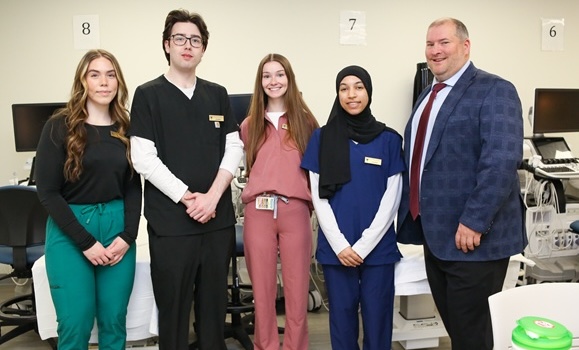
First year Bachelor of Health Sciences students (Diagnostic Medical Ultrasound Technology) with Nick Hilton (Ministerial Assistant to the Minister of Health and Wellness and MLA for Yarmouth).
This model allows students to build confidence and clinical competence while maintaining high standards of patient care.
“The opening of the Dalhousie School of Health Sciences Ultrasound Clinic is a prime example of how innovation, education and collaboration can come together to better support Nova Scotians,” said Nick Hilton, ministerial assistant, on behalf of the Honourable Michelle Thompson, minister of health and wellness “This clinic will not only expand access to diagnostic imaging, but also create high-quality training opportunities that will strengthen our health-care workforce.”
Collaborative clinical model
The clinic operates in close collaboration with NSH Central Zone Diagnostic Imaging. All patients are booked directly from the NSH Central Zone waitlist, ensuring the clinic contributes meaningfully to reducing diagnostic imaging backlogs.
All ultrasound examinations are interpreted and reported by radiologists at the QEII Health Sciences Centre, maintaining continuity and quality within the provincial health-care system.
Currently, the clinic includes two general ultrasound rooms operating one to two days per week. This spring, the program will expand operations to offer eight weeks of clinical placements running five days per week. This immersive experience is designed specifically to support first-year students, providing a consistent, supervised learning environment that bridges the gap between classroom learning and traditional clinical placements.
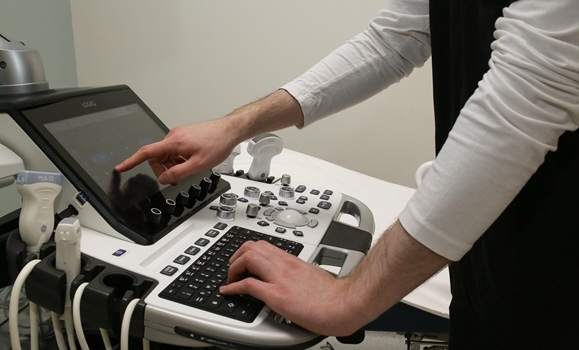
A student demonstrates controls of the GE HealthCare LOGIQ E10 Ultrasound.
To further support student readiness, the clinic is equipped with ultrasound machines identical to those used across clinical sites in Nova Scotia. This intentional choice helps ease students’ transition to other placements and into professional practice by ensuring familiarity with the technology they will encounter in real-world health-care settings.
Sophie Carmichael, a third-year student in the Bachelor of Health Sciences (BHSc) Diagnostic Medical Ultrasound Technology program, has been learning and honing her skills in the clinic along with the other students in her class since it opened in fall 2025.
“As a student, having the opportunity to learn in a slower-paced environment is extremely beneficial. The clinic experience has contributed to the development of both my confidence and scanning skills. In this profession, hands-on clinical experience is essential for effective learning. The clinic provides one-on-one time with our preceptor, along with a reduced patient load, allowing ample time to work through real clinical cases and receive detailed feedback from our preceptor,” she said.
Supporting patient access
It is estimated the clinic can support more than 200 patients per month, making a tangible impact on wait times while simultaneously training the next generation of sonographers.
“This clinic represents a true win-win,” said Catherine Gunn, SHS director. “Dalhousie is training future sonographers while expanding diagnostic ultrasound services for Nova Scotia patients at the same time. We’re changing the way we deliver education so we can address workforce shortages and impact patient wait times.”
The new clinic is only the second of its kind in Canada. Its development was informed by extensive research and key learnings from the Camosun College and Pacific Health Partnership clinic launched in Victoria, B.C., in 2023. By adapting and building on this innovative model, SHS has positioned itself as a leader in experiential health sciences education.
As demand for diagnostic imaging continues to grow, the new clinic stands as a creative, collaborative solution that strengthens the health-care system, supports student success, and delivers real benefits to patients across Nova Scotia.