

This week’s winter storm dumped 20-25 cm of snow in Halifax and Truro, a wallop that prompted what a Dal facilities manager suspects was the university's longest campus closure since a rare two-day shutdown in 2015.
The university closed all buildings and cancelled classes for the duration of this week's wintry weather, which began overnight Sunday into Monday and persisted, on and off with blowing conditions, well into Tuesday morning.
Dalhousie's Environment Services Manager Michael Wilkinson, who leads the university's snow and ice-clearing team with Facilities Management, says while this week's day-and-a-half closure was longer than one the Monday prior, the job of cleaning up was easier.
"This week's storm was nice, light, fluffy snow, so it wasn't as bad to deal with, but there was a lot of it,” says Wilkinson.
But he says that's not usually the case these days as closures due to freezing rain conditions are becoming more prevalent, like conditions during the shutdown on January 19, which he described as "very wet, heavy snow."
"That was harder on equipment, harder on people's bodies to physically move it," he says.
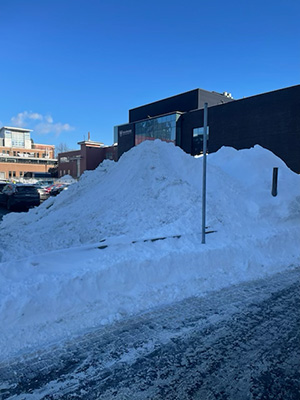
Shown above: Huge snow piles on Sexton Campus. (Submitted photo)
Not an exact science
Wilkinson is part of the cross-departmental group that provides critical input and data to inform the decision to declare a weather-related closure. There are a lot of factors to consider when deciding on whether to declare a weather-related closure, including bus cancellations, police recommendations, the volume and speed of snowfall, and pavement temperatures.
“We try as far as possible to make the right call, and it's not just me. It's a whole group of people that do it,” says Wilkinson.
Planning for major weather events takes a village. The decision to declare a “snow day” is often informed by many, including Wilkinson’s facilities management team, security officers on campus overnight, and senior administrative staff.
Mother Nature is very variable and changeable, but we use what we've got at our disposal and try and make a good decision.
While the team tries to look at as many different forecasts as they can — including Environment Canada, the weather network, and a fee-based forecast system used by their snow-removal contractor — Wilkinson acknowledges that the weather can still be unpredictable.
“It's not an exact science as much as people would like to think it is. Mother Nature is very variable and changeable,” says Wilkinson, “but we use what we've got at our disposal and try and make a good decision.”
All hands — and shovels — on deck
Clearing the snow is also a large, coordinated effort. Dal’s contracted snow-removal team of eight to 10 people worked through Monday night to keep fire lanes open and sloped areas cleared. Meanwhile, Wilkinson’s in-house team of 10 or more worked all day Monday and early morning Tuesday before campus reopened to clear sidewalks and other areas that the contractors’ large machinery couldn’t access, often hand-shoveling building entrances and stairs.
That meant a very early start.
“We were here for 5 a.m. back at it again [on Tuesday] so that we could try and get everything done before people got up and started moving around again,” says Wilkinson.
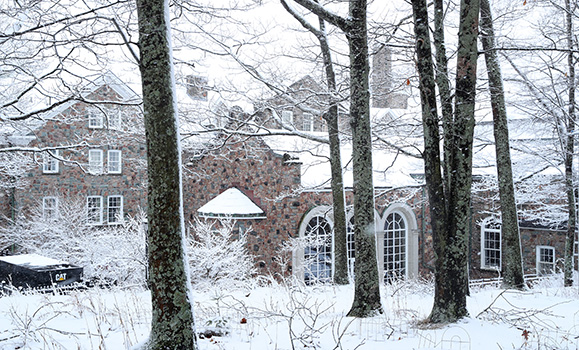
What is more predictable than the weather is the order of operations to Dal’s snow-removal efforts: the team starts with clearing snow around the residences, then animal-care facilities and accessibility features, the arts center, and fire lanes - then it’s on to systematically clear every other building the university operates.
Being on the snow removal team can be a lot of work, Wilkinson acknowledges.
“Especially if we get back-to-back storms. We've had winters like that. You know, people wear out,” says Wilkinson.
Wilkinson’s team is likely to have to jump into action again soon with another winter storm forecast for this coming Monday, which also happens to be Groundhog Day in Canada.
New approaches being tested on campus
To combat fatigue and worker injuries, Facilities Management is investigating new methods that will decrease the physical labour of snow removal and de-icing.
One method is putting out yellow SOS bins of rock salt around campus that facilities staff and members of the public can use to salt as is needed. “If anybody did need salt, they can use it,” says Wilkinson, “We did that also for our crews so that when they're out there, they're not having to come back to the central warehouse to pick up salt.”
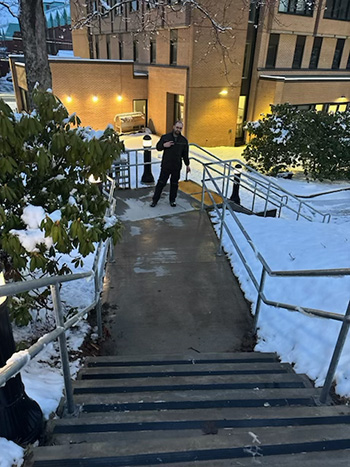
Shown right: A heat-trace system helped keep this set of stairs on Sexton Campus clear. (Submitted photo)
Another method is a heat-trace system, one of which is being piloted on a set of stairs on Sexton Campus behind Brian Hall. The technology is activated by sensors when there is snow buildup and melts the snow without any need for salting.
“I'm hoping to roll that out to other locations as budget permits.” says Wilkinson, “It's good for the environment, too, as it saves us putting salt down.”