

Human rights advocates describe them as inherent, inalienable, and universal — belonging to each person out of virtue of simply being human. Yet amid reports of expanding wars, rising authoritarianism, and democratic backsliding, watchdogs and advocates argue there has been an erosion of those rights.
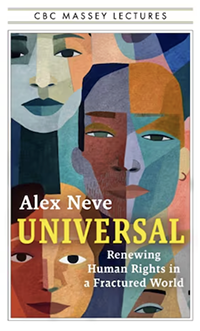 Alex Neve O.C. (LLB '87), a Canadian human rights lawyer and one such advocate, returned to his alma mater, Dalhousie, this week to share insights from his CBC Massey Lectures in a talk titled Universal: Renewing Human Rights in a Fractured World. The event was held Wednesday (Jan. 21) in the Schulich School of Law's Weldon Law Building.
Neve shared themes from his five-lecture series across Canada — also published in book form — on what happens when universality is treated as optional, when rights become exclusive, and when silence replaces solidarity.
Universality under threat
Adopted in 1948, the Universal Declaration of Human Rights (UDHR) laid the framework for an international order designed to prevent the very abuses that Neve and others describe unfolding across the world today.
That order, Neve argued, is now collapsing. “This is not universality's' finest hour,” he said. “But it can be.”
During his twenty years as secretary-general of Amnesty International Canada, Neve worked across the globe, fighting for rights he said are often universally declared yet routinely denied.
Human rights have become an exclusive club, steeped in white, moneyed, patriarchal privilege.
“Human rights have become an exclusive club, steeped in white, moneyed, patriarchal privilege," he said. “The clubhouse remains surrounded by fences of geopolitics, money, national security, intolerance, and indifference, which at times seems unreachable.”
Hope amid strife
And yet, amidst global strife, Neve said he witnessed hope that defied all cynicism. Even those who had endured the most violent human rights abuses clung to the promise of human rights, precisely because of its claim to universality. During his work with Rohingya refugees fleeing attacks in Myanmar, the UDHR became what they described as a lifeboat.
Universality became more than a legal concept, he said.
“[It] is linked to courage and imagination. It is fueled by conviction and hard work. It is nourished by solidarity, and it speaks truth that ultimately cannot be denied,” he said. “This universality yearns to unite us in something hopeful and good.”
Neve said he sensed an undercurrent as he made his way across the country to deliver his Massey talks.
“I have heard hope at every stop along the way. Hope that rests in deep concern, but in determination to work for change,” he says.
For Neve, this hope can help fuel a renewal of universal human rights, one built on six essential principles: putting human rights first, embracing universality, protecting human rights defenders, ensuring justice, being expansive, and believing in human rights.
Principle 1: Putting human rights first
Neve said the sidelining of human rights is often couched in a variety of excuses — too expensive, other priorities, or just simple indifference. The consequence of this inaction, however, is the perpetuation of human rights violations. With more communities displaced, livelihoods destroyed, and survival necessities stripped every day, Neve stressed the danger.
“Delaying human rights robs them of their purpose,” he says. “Human rights do not rise to the top after people have been decimated by genocide or come to the fore after economic policy and trade deals have gutted a community of their livelihood.”
Principle 2: Embrace universality and commit to equality
With equality rights under attack around the world, Neve urged Canada to use its diplomatic, political, and financial influence to commit to equality by promoting diversity, equity, and inclusion globally. To embrace universality, he believes Canada needs to begin domestically with full respect of Indigenous people, meaning all jurisdictions incorporating the UN Declaration on the Rights of Indigenous People into their laws.
He emphasized that refugees too must be treated as fully entitled human beings. Canada’s failure to suspend the Safe Third Country Agreement with the United States, he considers “a disgrace.”
Principle 3: Protect human rights defenders and the right to protest
Those who fight for change often bear the greatest risk, said Neve. With governments like China, India, Russia, Iran targeting journalists and activists, even across borders, Neves said: “We need to recognize the essential role of human rights defenders and peaceful protests in society, as sentinels of human rights protections and the lifeblood of democracy.”
That threat, he stressed, is not only abroad. In Canada, defenders – whether protesting on the streets or advocating within communities — continue to face criminalization simply for standing up against human rights injustices. Protecting them, and their right, is central to preserving democracy and the rule of law, Neve argued.
Principle 4: Ensure justice
“Enforcement of the universal promise is impossible if there is no effective remedy to turn to when rights are violated,” said Neve.
He outlines that Canada has been slow to ensure that its national courts play a meaningful role in delivering justice for those responsible for human rights violations. He called for increased support for the International Criminal Court.
Additionally, Neve argued to curtail the use of the notwithstanding clause in Canada’s Charter of Rights and Freedoms, which has allowed the government to sidestep accountability and deny human rights remedies for the most marginalized, vulnerable, and disenfranchised.
Principle 5: Be expansive
When the UDHR was written, issues including the climate crisis, the digital world, or global wealth inequality lay beyond their scope. While retreating to existing frameworks is tempting, Neve said, “we must ensure human rights are relevant to the challenges of today, including by evolving our understanding of human rights.”
Northern Quebec stands as an example of adapted understanding. The Magpie River, granted equal personhood, is now recognized not as an object to exploit but for a person to be protected.
Principle 6: Believe in and champion human rights
Ultimately, Neve insisted, all else is meaningless if people do not believe in and champion human rights. Gone are the days of neutrality; the time has come to take sides. By doing so, the message is clear: we are not indifferent to genocide, to a burning planet, to sexism, racism, and discrimination, to erasing trans lives, to shutting borders, to refugees, or to homelessness.
In a fractured world, this conversation has never mattered more, he said. Even a single person can spark change.
“When we believe, when we are empowered and bound to one another in solidarity, when we spread the word and protest, when we overcome doubt by making human rights real, when we defend human rights, when we set out to make change happen, even against enormous odds, and can and we do prevail,” he said.