

When humans need more Vitamin B12 — a nutrient that makes healthy red blood cells and turns food into energy — we can get it by taking a supplement or eating fish.
But what about ocean life, including the seafood we eat? Are they getting their vitamins and how do they access essential nutrients?
A recent study from Dalhousie and Bedford Institute of Oceanography (BIO) researchers analyzed five years of samples collected from the Scotian Shelf, a section of the continental shelf off Nova Scotia. They were seeking a better understanding of B-vitamins’ abundance in marine ecosystems, their impact on the food chain, and the ocean’s ability to supply vitamins to humans through important seafoods.
Former Department of Biology PhD student Dr. Catherine Bannon (PhD’24) was the study’s lead author, along with her supervisor Dr. Erin Bertrand, Canada Research Chair in Marine Microbial Proteomics (Tier 2).
In the ocean, vitamin B12 is only produced by marine microbes, which are undetectable to the human eye without a microscope.
The B-vitamins that are made by these small microorganisms are actually the B-vitamins that get to the food supply.
“The B-vitamins that are made by these small microorganisms are actually the B-vitamins that get to the food supply,” says Dr. Bannon.
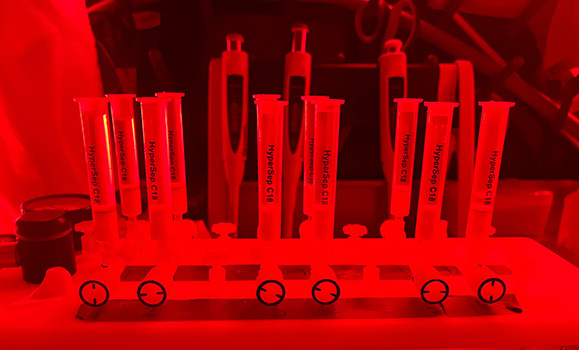
To guard against photodegradation, the study’s vitamin samples had to be processed in the dark, with a red headlamp as the only light source.
She says phytoplankton — floating plant-like organisms — rely on bacteria to produce the vitamin B12 they consume, and the fish eat the phytoplankton.
“These marine microbes and their interactions are the only source of vitamins in seafoods, meaning that to understand the future of vitamin supply to humans from the sea, we need to understand how, how much, and when they are produced by marine microbes,” adds Dr. Bertrand.
Shedding light on nutrient availability
Vitamins are hard to measure in the salty sea: they are present in very low concentrations, in many chemically distinct forms, and they degrade quickly when exposed to light.
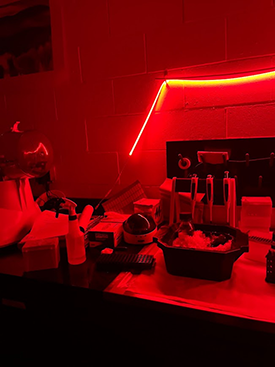 To start, the researchers worked to improve the methods used to measure vitamin B12 in the ocean. What they found over the course of their five-year survey was that production of the nutrient from marine microbes varied seasonally, from a spring bloom where B12 is enriched in plankton biomass to a fall decline.
While these findings improve our understanding of microbial vitamin supply, they also prompt more questions.
“How does climate change affect B-vitamin production in the ocean?” asks Dr. Bannon. “Is that going to have resulting effects on the food chain and the food web that supports our coastal communities?”
Dr. Bertrand speculates that as temperatures rise, overall nutrient availability in the sunlit surface ocean is expected to decrease, prolonging the periods of time that the North Atlantic has fall-like conditions.
“This has the potential to decrease the overall B12 supply available to higher trophic levels [bigger ocean animals up the food chain] in the ocean, with possible consequences for nutritional content in seafoods,” she says.
More to study
Dr. Bertrand notes that Dal researchers are continuing to explore vitamin production in the ocean, even as Dr. Bannon has moved on to become a postdoctoral researcher with the Max Planck Institute for Marine Microbiology in Bremen, Germany.
“We are using Dr. Bannon’s methods to monitor vitamin production on the Scotian Shelf and elsewhere in the North Atlantic and Arctic,” says Dr. Bertrand. “With this time series, we hope to be able to resolve patterns of change, in addition to the seasonal patterns Dr. Bannon revealed. We are also growing marine microbes in the lab to help us determine what drives their rates of vitamin production, and the amount of vitamins transferred when those microbes are consumed by other organisms.
“Dalhousie is well-positioned to help us understand the future of vitamin supply to humans from the sea.”