
| ||
|
“These doctors – they’d never be able to afford to come here. So it’s nice to have that influence, to teach and demonstrate technique so surgeons can deliver care to their own countrymen in their own surroundings.”
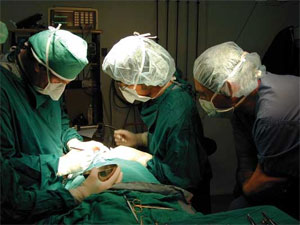
Along with a team of surgeons – he’s often joined by Dalhousie professors Reg Goodday, Archie Morrison, Chad Robertson and Ben David – he performs free corrective surgery on children with cleft lip and palate, and at the same time, trains and teaches local surgeons. The surgeries have dramatically transformed the lives of children born with the common facial deformity and even some adults who had lived with the condition untreated for years.
The surgeries have enriched his life as well. He enjoys the children and their families, the teaching and the friendship and fellowship with team members.
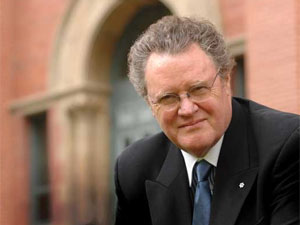
“Why do I do it? It’s simple really – It’s so rewarding, it feels almost selfish,” says Dr. Precious.
In May 2007, the internationally renowned teacher and oral surgeon was recognized for leading the international medical missions when he was named to the Order of Canada.
“It’s a privilege to work on these children and what we do is relatively straight-forward surgery which makes an enormous difference.”
One in every 600 to 700 children is born with a cleft lip and/or palate. Once derogatorily referred to as a “hare lip,” cleft lip and palate is a condition that occurs during development of the fetus, when the separate areas of the face don’t properly fuse together. A cleft lip (cleft meaning “split” or “separation”) is an opening in the upper lip between the mouth and nose. Cleft palate occurs when the roof of the mouth has not joined completely. Left uncorrected, children born with cleft lip and/or palate experience breathing, eating and speaking problems.
Back in his office in the Dentistry Building after performing surgery on a baby from Halifax earlier that day, Dr. Precious explains that in developed countries like Canada, the initial lip surgery is done on babies around six months of age, for future growth reasons.
“The goal is to get the nose straight, achieve symmetry of the lip, nose and muscles and to create a nostril you can breathe through,” says Dr. Precious, 64, who recently handed over the dean’s position to Dr. Thomas Boran. A founding member of the International Cleft Lip and Palate Foundation, Dr. Precious has been a professor with the Department of Oral and Maxillofacial Surgery for 35 years. He is also on staff at the IWK Health Centre and Capital Health as a senior oral and maxillofacial surgeon.
Dr. Precious embarked on his first overseas medical mission to Vietnam in 1995 after encountering
Nagato Natsume, director of the Japanese Cleft Palate Association, at a meeting of specialists in New York. Since that time, his ground rules remain the same: he’ll only go on the invitation of the country’s Ministry of Health and only as long as local surgeons will welcome them. “And we still insist on a team of Canadians, Japanese and Vietnamese,” he adds.
Those first missions went to Bên Tre, in the Mekong Delta area of southern Vietnam. But the team has since moved on to other locations because Vietnamese doctors are well equipped to handle the surgeries themselves – “and very well too,” says Dr. Precious. More recently, the team has visited hospitals in Võnh Long province, also in the south of the Southeast Asian country. And, for the past 10 years, the team has made annual visits to Tunisia, in North Africa.
“It’s not like M*A*S*H, by any means. But while not the same as North American hospitals, there are many things that are done so much more efficiently and at less cost… We definitely learn a lot too – this is not a one-way street.”