Within the Law faculty, MELP’s teaching and research continued and flourished under the guidance of rotating faculty directors such as Linda Duncan (LLM ’98), Dawn Russell, Hugh Kindred, Moira McConnell (LLB ’84), David VanderZwaag and Aldo Chircop. By 2003, it had become clear that the faculty’s cooperative research under the “Program” would be strengthened by the creation of a new structure—one that would foster more partnerships with programs here on campus and, as well, with other centres across Canada and around the world.
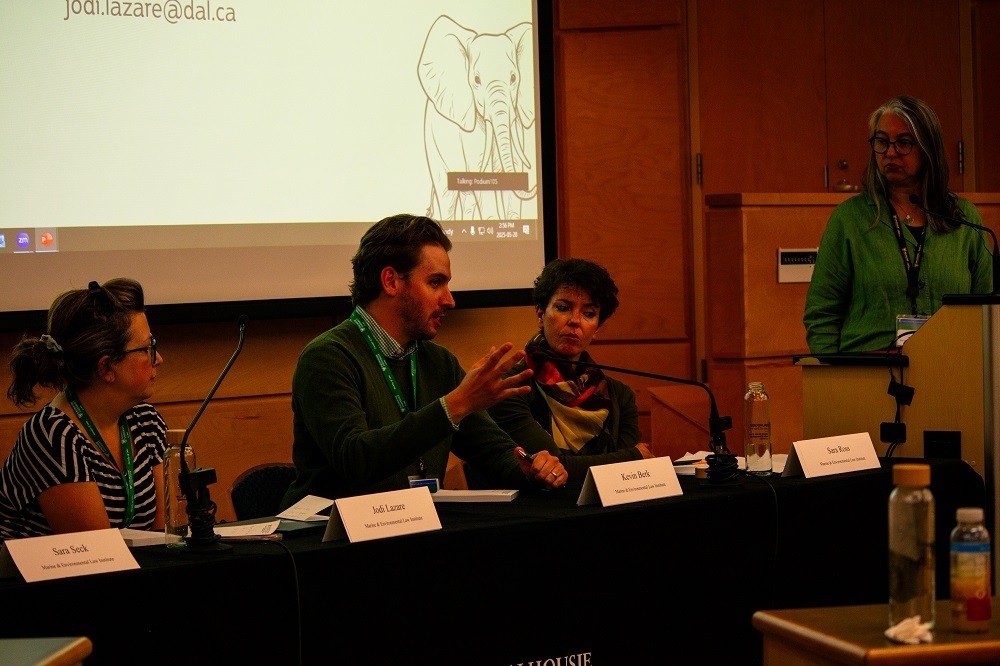
The Dalhousie Board of Governors formally recognized this legacy of research excellence on the part of Dalhousie Law School’s MELP faculty in 2004, with the creation of the Marine & Environmental Law Institute. The Institute, which is housed in facilities on the fourth floor of the Law School, carries out research and consultancy activities and also directs the MELP academic specialization. Its leading researcher is Professor David L. VanderZwaag, Canada Research Chair (Tier 1) in Ocean, Law and Governance. The Director is Professor Sara L. Seck and the Associate Director is Professor Sara Ross. Former Professors Gold, Charles, Gold, Hanson, Kindred, McConnell and Russell, along with Dal alumnus, Brian Flemming, are the Honorary Fellows of the Institute; MELP’s full and part-time teaching faculty are now the Institute’s Teaching Associates.
Thanks to a Canada Foundation for Innovation (CFI) grant, secured by Professor VanderZwaag, and other funds raised by former Dean Dawn Russell to match the funds from CFI, the Institute began its life with a generous research facility and space to host the many national and international visitors that come to use Dalhousie’s excellent specialized collection of the Law Library and to work with the expert faculty.
In addition to their teaching and scholarly research and publication activities, faculty associated with the Institute increasingly carry out research projects and are frequently invited to provide advisory services to agencies of the United Nations, such as the International Maritime Organization, the International Labour Organization and the United Nations Conference on Trade and Development, as well, international non-governmental organizations such as The World Conservation Union (IUCN) and the World Wildlife Fund (WWF). Regional organizations such as the Commission for Environmental Cooperation and the South Pacific Forum Fisheries Agency have also benefited from the work at the Institute. Many Associates have an involvement with national and local organizations such as Ecojustice, ECEL, Solar Nova Scotia, and G.P.I. Atlantic, as well as working with federal and provincial governments and agencies.
The Marine & Environmental Law Institute hosts the editorial office for the Ocean Yearbook, a major international multi-disciplinary annual of the International Ocean Institute, devoted to ocean affairs. Dalhousie Law students assist with editing the Ocean Yearbook and have the chance to gain experience working as research assistants on the Institute’s research projects and workshops.
The Marine & Environment Law Institute continues to work closely with on-campus student groups such as the Environmental Law Students’ Society and frequently collaborates closely with other faculties, interdisciplinary graduate programs and other scholars at Dalhousie University.