
News
» Go to news mainSocial media expert, Dr. Anatoliy Gruzd, advocates for ‘digital hygiene’ in fight against mis‑ and dis‑information
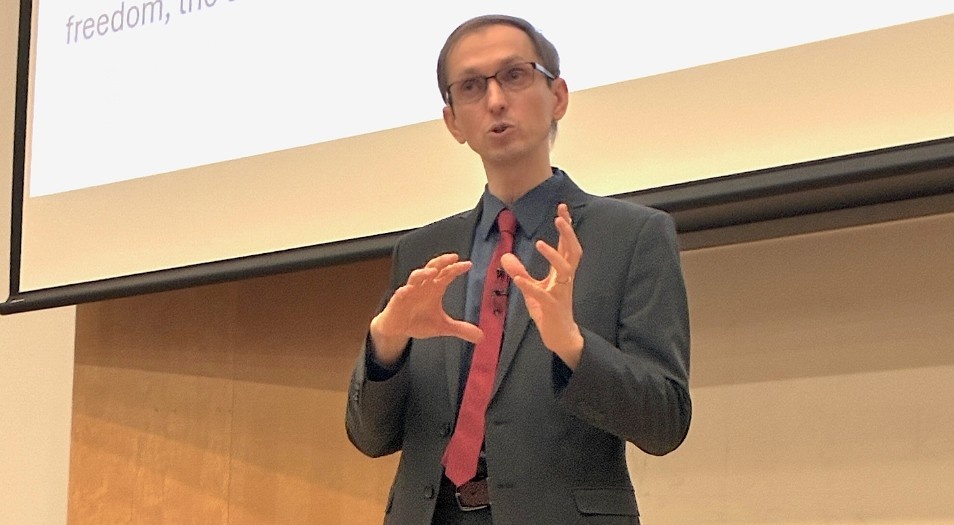
Social Media expert, Dr. Anatoliy Gruzd says it’s time to stop scrolling and to start thinking critically about what we’re seeing on our screens. Speaking to an audience of more than 350 at the inaugural Alan H. MacDonald Information Science Lecture, Dr. Gruzd made an urgent and compelling argument for good ‘digital hygiene.’
As co-director of the Social Media Laband a Canada Research Chair at Toronto Metropolitan University (TMU), Dr. Gruzd pays close attention to trends, technology, and how the two are being manipulated for malicious intent. “Social media is not innocent,” he told his audience.
Difficult to differentiate between what’s real and what’s not
Dr. Gruzd says it’s incumbent on individuals to actively question the content on their screens. It’s been more than 10 years since it became widely known that social media was being manipulated to impact the results of the 2016 US Presidential election. Even though the Internet Research Agency, the Russian propaganda company behind the lies, was criminally charged, Gruzd stresses that the advent of generative AI has made social media even more pernicious.
“It's not just those pictures of cats and dogs that everybody loves to like…and it's not just marketers that are trying to sell stuff, but it includes state actors and other criminals.” The wars in the Middle East and Eastern Europe, he says, have shown how AI helps fuel mis- and disinformation that then becomes part of the contemporary vernacular.
Posting a series of photographs on the screen at the front of the lecture hall, he asked the audience to identify which were real and which were fake. The success rate was low. “I needed to get their attention,” he says. “It's quite difficult nowadays to differentiate between what's real, what's not.”
Need to start developing skills early
But for Dr. Gruzd, the visuals are just the beginning of an investigation. “It's not just about image or video, but also, they (viewers) need to understand the context where it was shared, who might be benefiting from messaging, and who is sharing it.… I think when you start noticing those things, you become a critical consumer of information.”
‘Digital hygiene,’ he says, is something you build. He adds, “If you want to operate in this information-rich environment, you really need to start developing those skills early on.”
One of the functions of Dr. Gruzd’s Social Media Lab is to help the public identify ‘malicious content.’ Their Deepfakes Tracker page is a comprehensive collection of lessons on how to recognize AI generated imagery, and as well as technological tools to test the content.
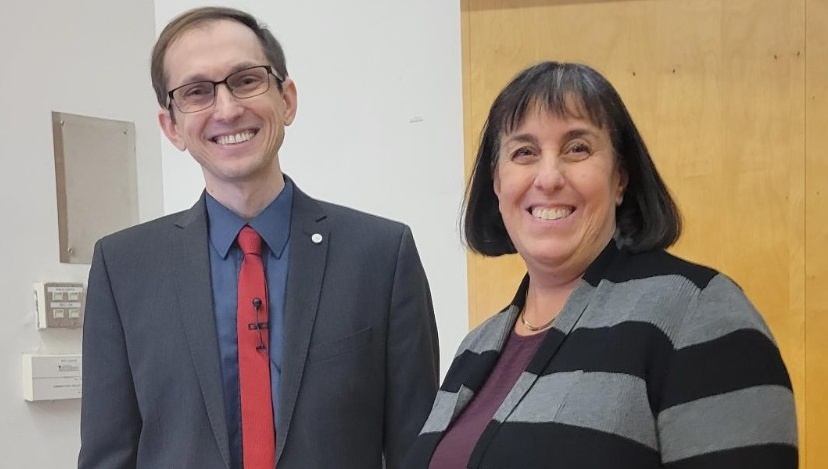
Above: Anatoliy Gruzd (left) with Bachelor of Management program director Paulette Skerrett
Growing gap between tools and their use
Dr. Bertrum MacDonald, a former dean of the Faculty, says it was fitting to invite Gruzd to give the inaugural lecture. Dr. Gruzd, he says, is very much like Alan H. MacDonald. MacDonald, who died in 2010 was “very attuned to the influence of new information technologies, and how the world around us is changing. He was an exceptional mentor to students and early career information professionals.”
The lecture could not have been more relevant. Earlier in the day, Dr. Gruzd appeared before the Senate committee on Transport and Communications to suggest that the Canadian government should require large platforms to use authenticity credentials to verify the accuracy of their content. He told Senators that research conducted in his lab shows “...there is a growing gap between how widely these tools are used and how prepared Canadians are to use them safely.”
Recent News
- With 70 years between them, a grandfather and grandson confirm the Bachelor of Commerce still has the same heart
- Nick Troup: An MPA designed for real life
- Brooklyn Malone (BSc(Rec)/BMgmt’26) on the art of opportunity and gratitude
- Varsity Athlete, Lydell Husbands‑Browne (BMgmt’26) pivots, on and off the court
- Social media expert, Dr. Anatoliy Gruzd, advocates for ‘digital hygiene’ in fight against mis‑ and dis‑information
- A guide to some of the best spots to study (and snack) at Dalhousie
- Building community and opportunity for Black and Indigenous students
- Dr. Maria Pacurar’s secret to teaching Fintech