EES Departmental Seminar: How Is Interferometric Synthetic Aperture Radar (InSAR) Transforming Our Understanding of Earth and Environmental Sciences?
Dr. Wanpeng Feng
Associate Professor Tectonic Geodesy
School of Earth Sciences and Engineering, Sun Yat-sen University, Zhuhai, China
Title: How Is Interferometric Synthetic Aperture Radar (InSAR) Transforming Our Understanding of Earth and Environmental Sciences?
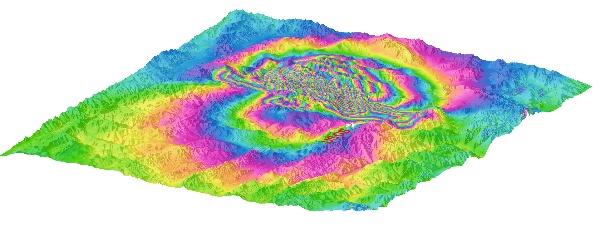
Abstract: Over the past few decades, Interferometric Synthetic Aperture Radar (InSAR) has emerged as a revolutionary tool. It has transformed our capacity to monitor surface changes across the globe with an unprecedented level of resolution. InSAR leverages two SAR images acquired from the "same" location to generate topography (such as SRTM), surface deformation, and coherence maps, which have been extensively applied in earth science. Specifically, InSAR techniques can reveal high-resolution geological catastrophic deformation processes. These include shallow large-scale earthquakes, volcanic eruptions, landslides, glacier movements and the stability of urban infrastructure. With the recent rapid growth of orbiting radar satellites, the revisit time of InSAR measurements has been shortened. This enables more frequent updates, higher temporal resolutions, and an increased likelihood of early risk detection. This talk will cover a broad spectrum of InSAR-related topics, spanning from fundamental theories to practical applications. Drawing on a diverse range of InSAR results, you will witness how InSAR is currently heating up in nearly every facet of earth science. As a case study, InSAR measurements throughout all phases of the earthquake cycle will be highlighted in this talk.
Bio: Dr. Wanpeng Feng earned his Bachelor's degree in Geology from China University of Mining and Technology (Beijing) in 2003 and a Master’s in Remote Sensing from the China Earthquake Administration in 2006, focusing on active faults and large earthquakes. In 2015, he received his PhD degree from the University of Glasgow, specializing in geodesy, with research stints at UC San Diego and the Earth Observatory of Singapore, expanding his work into earthquake physics. In 2015, he joined NRCan’s Canada Centre for Mapping and Earth Observation in Ottawa as an NSERC Visiting Fellow, contributing to the RCM radar system. After eight years abroad, he became an Associate Professor at Sun Yat-sen University in 2018. His research now focuses on space-borne InSAR time series and earthquake cycle studies.
Time
Location
LSC-812, 8th floor of the Biology/EES wing of the Life Sciences Centre
Additional Information
Meet the lecturer: COFFEE and COOKIES in B-3078 at 10:45 am