
Molly Ryan (BAH'18)
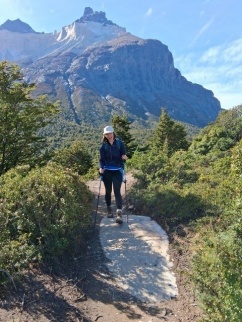
Molly Ryan (BAH'18) currently works as a Health Promoter with Nova Scotia Health

Molly graduated with a Bachelor of Arts with Honours in Social Anthropology
Molly Ryan graduated from Dalhousie in 2018 with a Bachelor of Arts (Honours) in Social Anthropology. She then went on to complete a Master's of Public Health from the University of Toronto (class of 2021). She currently works as a Health Promoter with Nova Scotia Health, which she says is a role that brings together policy, research, and working in partnership with community. Her day-to-day work focuses on sexual health and 2SLGBTQIA+ wellbeing.
Before joining Nova Scotia Health, Molly spent about 10 years in various qualitative health research roles. This included several rewarding years working in Halifax’s pediatric and adult intensive care units (ICU) focused on family, patient, and frontline clinician experiences.
We asked Molly to share some memories from her time as a Dal student, how her Arts and Social Sciences degree has helped her on her professional journey so far, and what advice she has for students.
In what way did your program help position you for and/or set you on your career path?
My social anthropology degree gave me a unique perspective in public health and health research spaces. It helped me develop a critical lens, think about the bigger systemic issues at play, and really value lived experience. There’s a lot of value in not taking things for granted! SOSA [Sociology and Social Anthropology] encourages students to be critical and curious about why things are the way they are: who benefits from current systems and structures? Who is missing from the table?
My Honours experience was particularly key in positioning me well for post-grad. Many other Honours programs will have students work on a piece of a professor’s established research program. The SOSA program expects and supports students in developing their own research question. Grads leave the program with experience designing and conducting a small-scale research project from start to finish. I’ve enjoyed visiting the SOSA Honours cohort as a guest speaker several times over the past few years to share the transferrable skills I’ve used in the workplace and how students might articulate these in their post-grad job searches. Beyond “hard” research skills like conducting interviews and using qualitative analysis software, my Honours experience introduced me to project management skills and how to navigate sensitive conversations. These skills were key as a research associate in ICU environments where I worked directly with bereaved families, for example. I even received a grant to lead a professional version of my Honours thesis project in the pediatric ICU context. I presented that research at a conference in Cancun – definitely my favourite unexpected outcome from my SOSA Honours training!
What's your favorite memory outside of the classroom, perhaps a club, event, or social moment, that helped define your Dal student experience?
Something that defined my Dal experience was being involved in the Unconscious Collective Vocal Ensemble, a Dal/King's a cappella choir. So many wonderful memories. It was a great way to switch off from work and school. Loved walking across the quad after late Thursday evening practices to go to Grawood open mic nights. My undergrad was full of music and some of the loveliest folks to make music with!
If you could give one piece of advice to an incoming first-year student, what would it be?
No one will care about your GPA in 10 years. So cliché but so true. What really matters is finding what works for you. The systems you use for studying, learning new material, meeting deadlines, balancing competing priorities – these are the same systems you’ll need in post-grad life. School is a relatively low-stakes time to play around and test out different strategies until you come to something that works well for you. Not that I’m promising you’ll have perfected it by the end of 4th year! :)
How did being in Halifax influence your university experience?
As a “come-from-away” who grew up in a small town by Lake Huron, the biggest influence probably came from staying on in the summers. Really living in the city and getting to know it outside of the rhythms of the school term. I met some of my closest friends by working as a tour guide during my undergrad summers.
Between off-campus jobs and being involved in various clubs, I made friends in many different programs and faculties. One of the best ways to switch your brain off from school is to have friends who have no clue what you’re studying and vice versa. Being in Halifax meant I also met and now know many more marine biologists and oceanographers than my friends who went to university in other cities!
What do you wish you had known earlier during your years in university that you know now?
I am embarrassed to admit it took me until late second semester of my first year to walk in Point Pleasant Park. The city has so much to offer. It’s easy as a first-year student to stay close to the Dal bubble. If I could go back to my first-year self, I would give her a nudge to get involved in non-Dal-life sooner!
Was there a specific course or professor that had a lasting impact on you and/or your career?
I chose Dal for their pharmacy program. And for the 2014/15 school year, I was a first-year pharmacy student. One of the pharmacy prerequisites at the time was a social science course. I originally wanted to take psychology but it was full, so I ended up taking intro to anthropology with Dr. Martha Radice. I LOVED it but I was so laser-focused on pharmacy that I didn’t really see a SOSA degree as an option. Still, Dr. Radice was the first person to encourage me to do SOSA Honours. After I shot down that idea with the stubbornness of an 18-year-old, Dr. Radice kindly provided a reference for my pharmacy application.
That intro anthro course and Dr. Radice’s encouragement planted the seeds that encouraged my eventual switch out of pharmacy. I couldn’t turn off the critical lens when it came to who could afford prescriptions and other access issues. This perspective helped me see my heart wasn’t in frontline care; it was in working on system-level problems. It turned out I also hated organic chemistry.
When I first transferred out of pharmacy, I thought I might do a double major in SOSA and Biology, but the more SOSA courses I took, the more at home I felt there. Dr. Emma Whelan’s critical health studies courses solidified my decision to do Honours. It was Dr. Whelan who told me I should do Honours if I wanted to leave the door open to graduate studies (thank you!!). It was a wonderful full circle moment to find myself in the 2016/17 SOSA Honours cohort supervised by Dr. Radice.
In the decade since that first anthropology course in 2013/14, Dr. Radice not only completely reshaped my undergrad trajectory, she recommended me for my first research assistant position and provided references for graduate school, scholarships, and several research jobs along the way. I’m incredibly grateful to Dr. Radice for that support and especially for igniting that first spark that led to my SOSA degree. My SOSA degree showed me a way to work at the intersection of health and social science, something that has defined my career.