News
» Go to news mainGrounded in Extraction: Architecture & Planning Students Shine at Nocturne

Each year since 2008, the Nocturne: Art at Night festival in Halifax has invited the public to change the way they see art—and their city. This year’s theme, “Ground,” asked artists to explore the physical, social, cultural, and political dimensions of the ground beneath us.
From land ownership and displacement to geology and infrastructure, the theme challenged participants to dig into what lies beneath and what it means to build upon it.
Once again, students from Dalhousie University’s Faculty of Architecture and Planning have stepped up to bring their own vision to life.
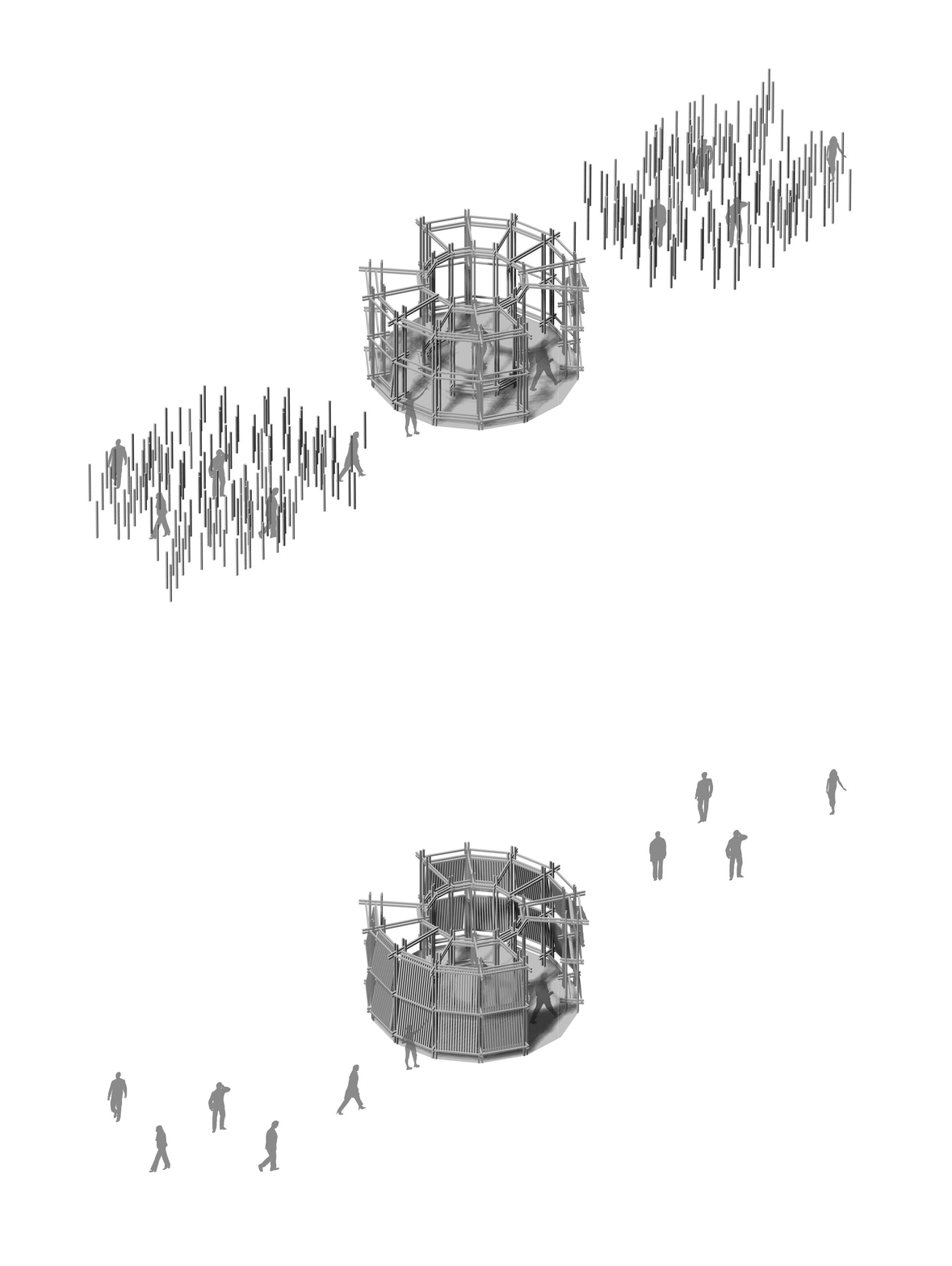
On display during the Main Project Showcase on Saturday, October 18, 2025, their installation, which interprets “Ground” through the lens of extraction, asks a fundamental question: What does it mean to build on land we’ve taken from the earth?
“Architecture and extraction are inextricably linked,” the student team explained.
“Grappling with our relationship as designers—and people—in the often one-sided relationship we have with the earth and its natural materials is one of the most important things we must do.”
The concept of “ground” is central to the installation. Rather than treating it as a neutral surface, the students challenge the assumption that the earth is a passive backdrop for construction.
“Architecture really challenges the idea of 'ground' as an unbroken plane,” they said. “Materials have to be pulled out of it and structures need to be placed into it.”
The design process was informed by research into sustainable building practices, including cradle-to-cradle cycles and “design for disassembly”—a strategy that allows buildings to be constructed, taken apart and reused rather than demolished and discarded.
“Our approach represents one of many paths to a more sustainable material future,” the team said. They also drew inspiration from Clara Mu He’s Harvard thesis on wood framing strategies.
The installation is the result of months of collaboration among students from all levels of the Faculty of Architecture and Planning.
Sub-groups focused on lighting, construction, research, and graphic design, ensuring that every element of the project was intentional.
“The project was entirely shaped by a collaborative design process and completed with the help of endless discussion and support,” they said.
Lighting plays a critical role in the installation’s transformation throughout the night. “From the beginning, lighting was considered a key tool in the narrative strategy,” the team explained.
“It makes evident the progress of construction in the project's transition from a glowing focal point to an enclosed microcosm.”
For many of the students, Nocturne represents a rare opportunity to bring their work into the public realm.
“Physically making a project which has a public presence is a rare and exciting thing to be involved in before becoming a practicing architect,” they said.
“We are able to work together across different cohorts of students and demonstrate the collective efforts of so many talented students to the wider community.”
The team hopes the installation will spark reflection and conversation.
“We challenge visitors to confront their own role and the role of architecture in extractive processes,” they said.
“We hope to leave visitors with the sense that we understand our responsibility as architects to continue to work towards sustainable futures.”
The installation was on display Saturday, October 18, as part of Nocturne’s closing evening. This project is a testament to the power of collaborative design, public engagement, and the urgent need to rethink how we build.
The design team was led by five Master of Architecture students—Blake Klotz, Camila Lima, Jacob MacDougall, Maya Kerfoot, and Melanie Roberts—alongside more than 40 students across the Faculty of Architecture and Planning.
Post-Event Reflections
“We were beyond thrilled with how the event unfolded. The process turned out to be intuitive and fun, drawing children and adults into the hands-on building experience. To keep the energy alive, we regularly re-spread the stakes, creating an endlessly kinetic life for the project. Visitors engaged deeply with the posters, and we felt our message was clear—making this installation a memorable showcase of creativity and collaboration between the faculty’s two schools.” — The Nocturne Team
Photography by Calum Molitor-Dyer


Recent News
- Celebrating Anna Brozek, 2026 Loran Scholar and Incoming BCD Student
- Grounded in Extraction: Architecture & Planning Students Shine at Nocturne
- Uncle Mel's legacy: A family’s journey through Dalhousie’s O’Brien Hall
- Designing Resistance: Celina Abba’s Journey from Biology to the Venice Biennale
- Hosting EDRA56: Putting Dalhousie and Halifax on the Global Environmental Design Map
- Building Futures: How Dalhousie’s Free Lab on Hornby Island Shaped a New Generation of Architects
- Dalhousie Impact Award Winner Recognized for Outstanding Contributions
- Dancing Between the Lines: Paulette Cameron’s Architectural Journey of Women, Space, and Transformation