
News
» Go to news mainMaking the Impossible Float: Dalhousie’s Concrete Canoe Team Paddles Back into Competition

Will Sayson had often wondered what it would feel like to sit in the middle of a lake in a canoe he had built entirely out of concrete.
After months of planning, designing, testing, building….and rebuilding, the fifth-year Civil Engineering student finally found out.
Earlier this month, Dalhousie Engineering’s Concrete Canoe Team travelled to Moncton, New Brunswick to compete at the Canadian National Concrete Canoe Competition (CNCCC). The event brings together civil engineering students from universities across Canada to design, build, and race canoes made entirely of concrete. Thanks to the efforts of Will and his teammates, it marked Dalhousie’s first appearance on the national stage in six years.
The Challenge
Their challenge was ambitious: build an 18-foot-long concrete canoe capable of floating and racing on open water.
“When people think ‘concrete canoe,’ it’s a bit of an oxymoron,”
“When people think ‘concrete canoe,’ it’s a bit of an oxymoron,” says Will with a laugh. “But huge container ships are thousands of tonnes and they still float.”
The key, he explains, is engineering the canoe’s density and structure. Every material used in the build had to balance strength, weight, and buoyancy.
The challenge, however, extended beyond the canoe itself.
With only a few months to prepare for this year’s national competition, the students weren’t just building a vessel from scratch, they were rebuilding an entire design team. In addition to designing the canoe, they also had to recruit members, secure funding, source materials, organize testing, and prepare the technical reports and presentations required for competition.
As team captain, Will oversaw nearly every aspect of the project, from early design discussions and recruitment to construction planning and competition logistics. Unlike many engineering design teams that have more than a year to refine their prototypes, the Concrete Canoe Team had just a single academic cycle to move from concept to competition.
“Even before the team was official, we were already brainstorming designs and taking stock of what resources we had available,” says Will. “Once recruitment started, we were surprised by how much interest there was from students.”
By the end of the year, the team had grown to more than 40 members, many of them first-year engineering students eager to gain hands-on experience early in their university careers.
The Design
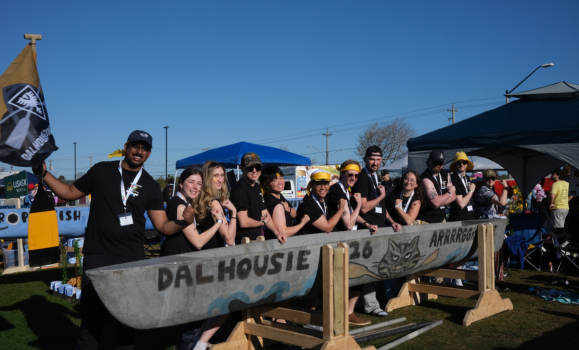
From choosing the perfect concrete mix to selecting materials that balance strength and buoyancy, Will and his teammates put everything they had learned in their civil engineering courses to work. Structural design, material science, and fluid dynamics all played a role in making sure that the canoe could not only float but could also race successfully in competition.
“The canoe is made from materials such as lightweight volcanic rock, recycled glass, expanded polystyrene, micro-fiber reinforcement, a basalt mesh, as well as an innovative carbon-negative admixture,” says Will. “The combination of these materials keeps us afloat, the boat structurally stable, and even reduces our carbon emissions.”
The team was also be able to draw on the experience of past Dalhousie Concrete Canoe teams who had competed in national competition.
“We’re glad to have revived a design team with such a rich history at Dalhousie. The old generations of the team won bronze nationally in 2005 and hosted the competition right here in Halifax in 2008,” says Will. “We’re very proud to carry on the legacy after the team stopped operating due to COVID.”
The Competition
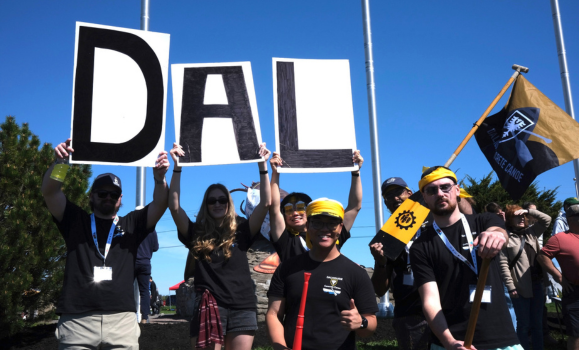
By the time the team arrived in Moncton, months of planning and preparation had finally come down to a single moment: getting the canoe into the water.
The CNCCC however, is far more than just speed alone. In addition to on-water races, students are evaluated on technical reports, presentations, design innovation, construction quality, and overall performance throughout the competition. Canoes must also meet strict safety and structural requirements while remaining buoyant under full load.
For Dalhousie’s team, simply making it to the starting line already felt like a milestone.
“Being a new team, our humble goal from the start was simply to attend the competition and not sink,” says Will. “We were so happy when we saw the canoe float, passed the swamp test, and were deemed eligible to race”
Over the course of the competition, the team competed in sprint, endurance, and co-ed races while also presenting their technical work to judges. By the end, they returned to Halifax with more than just competition experience. They also brought back one of the event’s 10 special awards: Best Engineer’s Notebook, Dalhousie’s first CNCCC trophy in 21 years.
“We all jumped from our seats when they called Dalhousie University for the Best Engineer’s Notebook award - the whole room cheered us on,” says Will. “I’m very proud of the team to have brought back another CNCCC trophy after all these years.”
Moving Forward
Since returning from Moncton, the team has already started reviewing what they learned throughout the competition and how they can build on that experience next year.
“Now that we’ve actually gone through the process, we understand so much more about what works and what we can improve on,” says Will. “There’s definitely a lot of excitement about taking what we learned this year and applying it to next year’s canoe.”
For Will, however, this season marks the end of his time with the team.
Originally from New Brunswick, he came to Dalhousie in 2021 looking for a balance between hands-on work and technical problem solving. Before reviving the Concrete Canoe Team, he was already involved with Dalhousie’s Solar Car Team, but says he was searching for an experience more closely connected to civil engineering.
“Despite already being involved in design teams, and going into my final year, I was craving some more technical experience that was related to my discipline,” he explains. “A few of my peers felt the same way, and that’s really how the idea started.”
Now preparing to graduate and begin work as a project coordinator with a construction company in New Brunswick, Will says rebuilding the team has been one of the most rewarding parts of his university experience.
“Joining design teams has been such a great experience because it gives you the chance to apply what you learn in class to something real,” he says. “But more than that, it’s the people and the sense of community that make it special.”
And while he won’t be returning to competition next year, he says he’s proud to leave the team in a much stronger position than when it started.
Recent News
- Dalhousie Hydrogen Lab Joins International Program for Hydrogen Appliance Testing
- Making the Impossible Float: Dalhousie’s Concrete Canoe Team Paddles Back into Competition
- Designing Productivity 2026
- Engineering students explore what it would take to save a Cape Breton lighthouse
- Chorus Aviation Announces New Gift to Expand Access to Engineering Education
- DalSolutions: How Dalhousie is helping to transform Nova Scotia into a global hub for carbon removal
- Building a Safer Future for Nuclear Energy
- Indigenous Knowledge Reshapes Engineering Education at Dalhousie