Cameron Deacoff's Story
Beyond the Degree: Real-World Impact After Marine Affairs
Imagine finishing high school in Aldershot, Ontario, in 1993, getting an environmental science degree from the University of Guelph, and then wondering, "What’s next?" That was Cameron back in the early 2000s. After graduating, he took a unique job as a fisheries observer in Alaska. He spent about 15 months out on the water, watching fishing operations and collecting data. This experience was huge for him. It made him realize he wanted to work in "managing the coastal areas somehow or other."
He quickly learned that to do anything valuable in this field, and to get the kind of jobs he was interested in, he’d need more education—specifically, a master’s degree. So, the search began.
Stumbling Upon the Marine Affairs Program
Sometimes, the best opportunities appear when you least expect them. Cameron practically "stumbled onto the opportunity for the Marine Affairs Program (MAP)" at Dalhousie University in Halifax, Nova Scotia. This was just weeks before the application deadline in February 2001! He was drawn to it because it seemed like a perfect fit, and he even got a faculty graduate studies scholarship. So, he packed his bags and moved to Halifax, a city he'd never even visited before. It was a big leap, but one that would shape his future.
The Marine Affairs Program: A Game Changer
The Marine Affairs Program at Dalhousie proved to be an essential part of Cameron's career journey. Even though there was a significant time gap (from 2002 to 2020) between finishing MAP and starting his current high-level job, he emphasizes that MAP "was instrumental in me getting a lot of the positions and experience that enabled me to get here." He adds that "all of the experiences that I began getting... I would not have had available to me had I not completed the program."
So, what made MAP so special and impactful?
Learning About Many Things: Unlike other graduate programs that were "more narrowly focused on one or two or three areas," MAP was interdisciplinary. This means it covered a wide range of subjects related to oceans and coastal areas, blending science with social sciences such as policy and law. Cameron liked this because he "didn't really know what I wanted to do" and didn't want to specialize too early. He found the "science and technology course" particularly beneficial, as it helped him understand broad, multidisciplinary fields of study.
- A Quick Pace: The program was a one-year (16-month) commitment, which was a significant attraction for Cameron ("get in, get out, move on"). This made it an "easier commitment to make" without a super clear plan for after graduation.
- Location, Location, Location: Being in Halifax was a considerable advantage. As Cameron points out, Halifax is "a major one [ocean science center] in Canada," with significant federal government offices, academic institutions, and other organizations focused on marine work. This creates "a lot of things you can do" and makes it an "attractive place to live and do work and study."
- Building Connections: One of the biggest benefits for Cameron was the "very broad and strong professional network" he built through MAP. He met many people in the field, and these connections have been "very instrumental" throughout his career. In fact, he even secured his first big internship through a MAP colleague. Dr. Bruce Hatcher, the MAP director at the time, also served as a significant mentor, offering support for job applications and certifications.
- Helpful Skills: The program helped him to "understand and weigh and communicate effectively with all kinds of different backgrounds." This was crucial because, in his later roles, particularly with the Halifax Regional Municipality, he had to interact with a diverse range of professionals, including engineers, planners, and technicians.
Cameron recalls no strong dislikes about the program itself, though he humorously notes that he started drinking coffee during the program and hasn't stopped. He also missed the international students, with whom he primarily socialized, when they left at the end of the program, and now only sees them online.
What Came After MAP? A Winding Path
Cameron’s career path after MAP wasn’t a straight shot, but each step built on the last, demonstrating the foundational strength MAP provided:
DFO Internship: His first significant step after MAP was an internship with Fisheries and Oceans Canada (DFO), specifically with the Oceans Coastal Management Division, secured through a MAP colleague.
Varied Contract Roles: For three to four years, he took on several contract jobs, including work with MAP itself and NGOs (Non-Governmental Organizations). This period of varied roles helped him gain diverse and valuable experience across different parts of the environmental sector.
First Permanent Job (Halifax Regional Municipality): This culminated in his first permanent career position as the "sole water resources professional" for the Halifax Regional Municipality. This was a crucial step, as it provided him with significant experience in project management and working with diverse disciplines. He even led multiple watershed studies and developed the first protocol for the Municipality’s response to blue-green algae blooms, which has since been refined and adopted by others. He also led a major, three-year project to conduct LiDAR flyovers (a type of aerial mapping) of the entire municipality with federal support.
Current Role (Provincial Government): All that experience gained at the municipality was instrumental in securing his current position in 2020: a Surface Water Quality Program Manager/Specialist with the provincial government. In this role, he primarily manages water quality monitoring programs, reviews environmental assessments, and provides technical advice. He notes that a significant portion of his time (20-30%) is spent "working with our inspection compliance and enforcement team" on major files, including those related to gold mines. He also actively tracks blue-green algae blooms.
Looking Back and Looking Forward
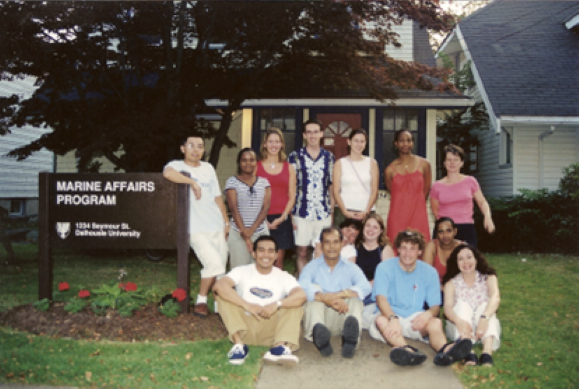
Cameron unequivocally states that the Marine Affairs Program was a key "foundational stepping stone" for his diverse career in environmental and water resource management. Its interdisciplinary approach, practical duration, and strategic location in Halifax provided him with the broad understanding, essential skills, and critical professional network that propelled his journey through various public sector roles to his current position.
He's still actively working on critical water quality challenges and policy development. Looking to the future, he sees a strong push towards economic growth, governmental responsiveness, and efficiency (less "red tape," faster processes) within the provincial government. He also sees AI as a growing factor and hopes to contribute to making government more responsive to the needs of Nova Scotians in water and resource management.
Cameron's insights highlight the complex interplay between different levels of government in coastal and water management—a critical area for future academic and professional development. His story shows that sometimes, the path to your dream job may involve a few detours, and finding the right educational program can make all the difference.