
Winter 2015 Interprofessional Heath News
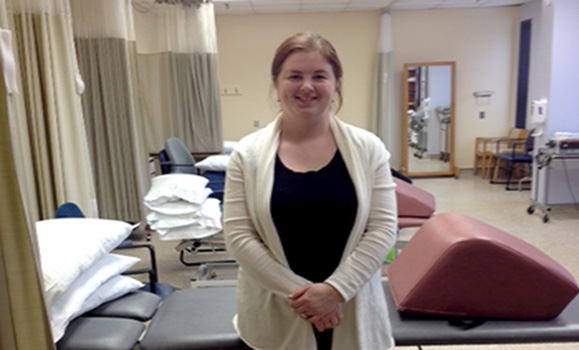
Second year physiotherapy student, Holly Gallant took part in the stimulated client collaboration with Occupational Therapy students.
By Jocelyn Adams, Communications & Special Projects Assistant
This fall, the Schools of Occupational Therapy and Physiotherapy provided a unique experience for their second year students. As part of the second year Neurological Physiotherapy Practice course (Module 7), physiotherapy students collaborated with occupational therapy students for an interprofessional intervention with a simulated client. The collaborative learning opportunity allowed students from each profession to observe their colleagues’ techniques, to share knowledge and expertise.
Preparing for the lab is where the learning develops between the two professions. “The special part is the optional interprofessional preparation lab that preceeds the evaluation. This time is extremely useful for students to meet and practice clinical skills together,” said physiotherapy faculty member Gail Creaser.
For students, the preparation lab was extremely useful, “The prep lab was very useful in order to divide the work between the PT and OT(students) ahead of time. It was great to have feedback from the other student,” said second year physiotherapy student, Holly Gallant.
“The OT and PT students learn many of the same skills but at different times. We learn from one another and reinforce our own learning by teaching the skills we have learned in our respective programs,” said Gallant.
According to Creaser the collaborative learning experience is well liked by students of both schools. “Every year it’s fully subscribed. It’s an opportunity for students to teach each other skills specific to their profession.”
“It allows students in an examination situation to demonstrate their abilities to communicate with each other, to think on the spot and observe each other when providing care to a client,” said Creaser.
Students are evaluated on how well they work together as a team, their collaboration with the client and their hands on skills. “Students are prepared to complete an ADL transfer, which is very common when treating clients recovering from a stroke,” said Creaser.
Learning through observation is a tremendous opportunity. “Students clarify different techniques and approaches to the situation. Together, students can negotiate how they would help each other, practice with each other, share the role of therapist and see various techniques.
“Physiotherapists and Occupational Therapists are a natural working fit in public health,” concludes Creaser.