
Spring 2017 Faculty Profile
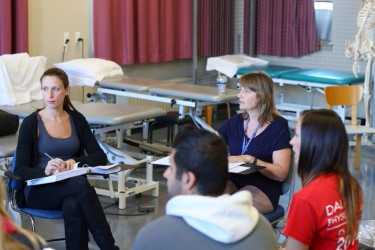
Gail Creaser with School of Physiotherapy students.
Each season, Physiotherapy Matters highlights the experience and accomplishments of a faculty member from the School of Physiotherapy. This spring, we are pleased to share the varied and collaborative career of clinician and lecturer, Gail Creaser.
Gail had not considered pursuing a career in physiotherapy until her physical education teacher suggested it during her final year of high school. Based on this advice and with the help of her guidance councillor, Gail enrolled in Dalhousie’s diploma Physiotherapy Program in 1975. “This was back when the School’s administration and library were in the upstairs of a small house on the corner of Robie Street and University Avenue – the location that now houses the NS Archives. Gail recalls “Our labs were conducted in the windowless basement of the Tupper Building.” Following the diploma program, Gail went on to complete the BScPT program in 1979.
Following her graduation from Dalhousie, Gail practiced in several Canadian Provinces, New Zealand and even Kuwait. In Kuwait, Gail started as the Senior Physiotherapist and then moved into the role of Clinical Residency Program Coordinator. “The Kuwait-Dalhousie Project”, Gail shared, “was a fabulous and challenging opportunity of learning about, and being integrated into, the Kuwait health care system. I found travelling in Kuwait, meeting Kuwaiti physiotherapists and visiting departments throughout the country fascinating. My experience is that physiotherapists wherever, love to gather socially, to share how they practice, to question each other and to find ways to have fun.”
Returning to Canada and to Dalhousie in 1997, Gail worked as a Continuing Physiotherapy Education Coordinator, Lab Demonstrator and then Sessional Lecturer. After the completion of her Master’s in Arts in Education at Mount Saint Vincent University in 2006, Gail continued in what is now her present role as Lecturer in the School of Physiotherapy. Her contributions to the School are enhanced by her ongoing clinical work with the NS Rehabilitation Centre (QEII HSC) as a staff physiotherapist.
As a Lecturer, Gail is committed to teaching “evidence-based care” to our physiotherapy students. While she instructs best evidence in the formal curriculum, through lectures and labs, she models evidence in practice as a clinician. “Patients and/or care-givers require the best evidence we can offer; why do we measure, how do we determine change, on what do we base expectations for change.” Gail continues to explain, “The health system relies on our expertise. Students’ access to the research literature, to robust outcome measures, normative values and research opportunities are better than ever.”
When questioned about the challenges she faces in combining her clinical and teaching roles, Gail admits that scheduling is probably one of the biggest challenges; other than that she finds it to be an excellent and beneficial fit for either role. Gail finds that she is regularly practicing skills clinically, that she will in turn instruct students to do in the labs.
As a member of Collaborative Inter-professional Health Education team, Gail contributes to the design, case development, scheduling and flow, and student evaluation and presentation of events at conferences. Gail finds working with faculty from other schools rewarding and appreciates the benefits of learning about their practices. “Inter-professional education is never dull and never the same,” Gail offers, “the design changes every time depending on the participating schools.”
With 40+ years in the practice, Gail continues to be inspired by Physiotherapy. She is excited about how the understanding in neuroplasticity is profoundly changing the approach to rehabilitation. “It [neuroplasticity] did not exist when I began physiotherapy”. Teaching initiatives, such as site visits to hydrotherapy labs in the new QEII pool, clinical interactions with client volunteers, rolling out new inter-professional collaborative encounters, as well as committee and community involvement, all keep Gail’s days interesting and busy.
When asked what she would like to share with incoming and graduating students of the School of Physiotherapy she advised, “Honour the trust people place in you by doing your best. Work hard, study hard and keep learning.” Great advice, and advice Gail can be seen exhibiting, in her unassuming way, every day as a faculty member of the School of Physiotherapy.
Gail is highly respected by her colleagues and students. According to School of Physiotherapy Instructor, Barbara Kelly, “Her constant positive attitude, tireless work ethic and great sense of humour are inspiring…She is an excellent teacher and very passionate about her work.”
For this reason, among many others, it is not a surprise to us that Gail has received a variety of academic and professional awards including the prestigious and nationally recognized, Mentorship Award from the Canadian Physiotherapy Association in 2014, and most recently the Faculty of Health Professions’ Will Webster Excellence in Interprofessional Education Award for her involvement on the Interprofessional Stroke Team.
Diane MacKenzie, Gail’s colleague on the Interprofessional Stroke Team shares, “I have had the pleasure to collaborate with Gail for more than 10 years as a colleague with the interprofessional (IP) stroke encounter. Gail has been instrumental in growing our IP stroke encounter from the original 2 programs (occupational therapy and physiotherapy) to include approximately 400 learners from 6 different disciplines. Gail's ability to understand the importance of discipline specific as well as IP competencies allows her to be a champion not only for physiotherapy students, but for all students. I have admired Gail's drive to make educational encounters relevant, evidence informed, and inspirational for students.”
On behalf of the School of Physiotherapy we would like to congratulate Gail on her well-deserved success!