
Spring 2015 Faculty Profile
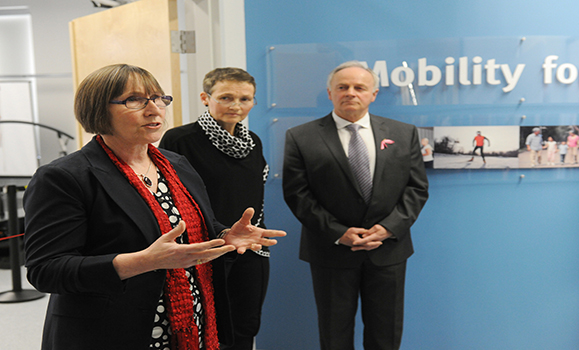
Dr. Cheryl Kozey, Associate Dean of Research (Faculty of Health Professions) is this spring's faculty feature.
By: Jocelyn Adams, Communications & Special Project Assistant
Each season, Physiotherapy Matters features the experiences of faculty members from the School of Physiotherapy. This spring, we’re proud to share the vibrant and dynamic career of Dr. Cheryl Kozey. At Dalhousie, Cheryl wears a variety of hats including professor in the School of Physiotherapy, with cross appointments in Biomedical Engineering and Health and Human Performance. Presently, she is the Director of the BioMedic NSERC CREATE training program in Biomedical Engineering and is the Associate Dean (Research) in the Faculty of Health Professions. Cheryl’s experience provides students, faculty and colleagues with an invaluable perspective of Dalhousie University.
Cheryl’s interest in human movement started at a young age. She began her studies in Sports Science from the University of New Brunswick, later traveling west to complete her Master’s in Kinesiology from the University of Waterloo. “While studying in Waterloo, I had the opportunity to work in the Rehabilitation Department at Toronto’s Wellesley Hospital. My job was to facilitate research among the physiotherapists and occupational therapists which tweaked an area of interest,” said Cheryl.
While at Waterloo, a position came up at Dalhousie’s School of Physiotherapy. At the time, the Director of Dalhousie’s School of Physiotherapy was visiting Waterloo and Cheryl’s mentor advised they connect. Following an interview in Halifax, she received an offer in a tenure track position at the Dalhousie School of Physiotherapy. “The job was exactly what I was looking for at that particular point in time. At that time given there were no PhDs on faculty, I was able to take on the job. One of the key requirements was to increase the research focus within the physiotherapy program. This was done primarily through a collaboration with Dr. William Stanish in Orthopedics, Professor Brian Westers and Dr. Jim Wall in Physiotherapy and our Research Methods course. I had a lot of wonderful students who I supervised during this time and we had a lot of fun," said Cheryl.
The School of Physiotherapy’s research focus continued to grow. The Master of Science (Physiotherapy) entry level program evolved, creating the Research Master’s program and now the Master of Science Rehabilitation Research. “This was just another step in building the research focus within the School,” said Cheryl.
To further her career, she decided to continue her education. After looking at many universities, her best decision was to complete her PhD in Halifax. She continued her education at Dalhousie University and completed her PhD in Physiology and Bio Physics with Milan Horacek. “While my PhD was in electrocardiology, there was an overlap with what I was interested in doing, with respect to looking at electromyographic signals of skeletal muscles, so rather than uproot the family I stayed here” said Cheryl.
Cheryl's passion for human movement and joint disorders later resurfaced. After working in electrocardiology for eight years she moved back into her passion. “I started taking students and getting back into bone and joint disorders. My interest was in the lower back and the knee joint as both require muscles to maintain their stability – I was always interested in muscle physiology and biomechanics,” said Cheryl.
Mentoring students led to a research path in lower back pain. “My very first student, Joanne Vezina and I looked at trunk muscle activation patterns during therapeutic exercises in individuals with lower back pain and how their muscles were disrupted compared to healthy controls and were one of the first to look at temporal patters too examine muscle synergy. I continued down this path with several other students. Presently we have a nice body of literature in this research area,” said Cheryl.
The other area of research interest focused on knee osteoarthritis. At the beginning Cheryl collaborated with colleagues Dr. Kevin Deluzio from the School of Biomedical Engineering, and Dr. Stanish from the Department of Surgery. These collaborations have grown to include a number of other researchers both within and external to the School and Dalhousie. Students from various backgrounds begin to collaborate. “We had physios working with engineers, who were working with kineosiologists. The physiotherapy students were programming in MAT lab and engineering students learning anatomy. It was a very vibrant group. Everyone was trying to improve our understanding of early knee osteoarthritis,” said Cheryl.
Few research groups focused on early knee osteoarthritis. Prior to Cheryl’s group, most were focusing on the end stage of osteoarthritis. “We were one of the first groups to look at early knee osteoarthritis, exploring how the muscles were altered to better understand how and when we could intervene. The group used gait or walking as a model to study,” said Cheryl.
Beyond Cheryl’s extensive contributions to research, she has held a range of leadership roles across Dalhousie. In 2006, she served as acting Director of the School of Physiotherapy from January to June 2006. From 2006-2009, she held the position of Director of Biomedical Engineering. In this role, she worked alongside Deans from Engineering, Medicine, Dentistry Science and the Vice President Academic. “There were a lot of interesting interactions. It was valuable to see the processes of different faculties and this gave me a stronger perspective of the overall university,” said Cheryl.
Presently Cheryl holds the position of Associate Dean of Research for the Faculty of Health Professions. She explains the most rewarding aspect of this position is the mentoring component. “Helping young faculty members move through and to develop their career. This position requires a lot of mentoring. To enhance the research culture in the Faculty of Health Professions, I try to provide mentorship for individuals across the Schools. I have my graduate students who have also given me a tremendous amout of satisfaction. I have another layer of mentoring,” said Cheryl.
Looking to the future she plans to continue her involvement with national organizations and publish a book. “I’d like to be involved with national organizations in a leadership role to be able to mentor, educate and translate information. Another goal is to publish a book on osteoarthritis, combining the last 15 years of research in this area,” said Cheryl.
Working at Dalhousie has been a very rewarding experience. “What I’m most happy about is how successful our graduates have become in their chosen fields. Whether students furthered their academic career, went back to clinical practice or assumed health administration position, the most fulfilling part is seeing students evolve into successful colleagues,” reflects Cheryl.
Cheryl provides advice to students interested in pursuing a career in research. “Students need to look at the types of opportunities available. The earlier you can do this the better. Then look at environments that will support your area of research and evaluate their success. Make sure you find out what you want to do early, even if it means volunteering to get a taste of it. A key is passion for new knowledge and understanding to go down the research road.”