
Dr. Shaun Boe
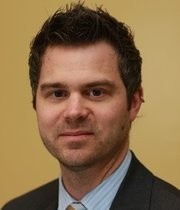
It’s about giving people motor function and it’s about the way we deliver health care. The ultimate goal is to improve health care in people recovering from stroke.
~ Dr. Shaun Boe
Education
- 2002 - BPhEd Hon (Kinesiology); Brock University
- 2006 - PhD (Kinesiology); the University of Western Ontario
- 2008 - MPT; the University of Western Ontario
- 2008-2010 - Fellow, Heart and Stroke Foundation Centre for Stroke Recovery
After completing a Fellowship in stroke-related neurosciences, Dr. Boe joined the faculty at the School of Physiotherapy as an Assistant Professor in 2010. Dr. Boe holds cross-appointments in the Department of Psychology and Neuroscience and School of Health and Human Performance, as well as an Affiliate Scientist position in the Department of Medicine at Capital Health. He is also an Associate Member of the Centre for Stroke Recovery, and an Adjunct Scientist at the Toronto Rehabilitation Institute. In addition to being Director of the Laboratory for Brain Recovery and Function in the School of Physiotherapy, Dr. Boe teaches Neuroscience for the Occupational and Physiotherapy students.
Research Interests
According to the Heart and Stroke Foundation, 300,000 Canadians are living with the effects of stroke. The foundation estimates that stroke costs the Canadian economy $2.7 billion a year and getting stroke survivors to regain as much independence as possible is the goal of rehabilitation programs. But full recovery from a stroke is still illusive. For instance, less than five per cent of stroke survivors recover full function of the affected upper limb. Dr. Shaun Boe, faculty member in the School of Physiotherapy, says that emphasis is usually put on getting stroke patients up and walking. “With limited health resources, upper limbs tend to get less attention,” he says. So how do you change this and develop better rehabilitation methods? One way is to study a modified treatment approach for rehabilitation. The other is to use advanced neuroimaging techniques to examine how areas of the brain are connected after stroke and recovery. Finding ways to help stroke patients recover more upper limb movement is the focus of Dr. Boe’s research.
Dr. Boe joined the School just over three years ago, and has been awarded funds from national, provincial and local granting agencies. His research activities have been recognized by Early Career Research Awards from the Heart and Stroke Foundation of Canada and the Faculty of Health Professions at Dalhousie. Two projects will be highlighted.
One of the projects is the “Atlantic Canada Modified Constraint Induced Movement Therapy (mCIMT) Trial.” In a nutshell, mCIMT restrains a limb that is not affected by the stroke, while using the affected limb to make movements and perform tasks. It’s well known that physical rehabilitation drives changes to the brain. As a result of the patient engaging in repetitive exercises with the affected limb, the brain grows new neural pathways that compensate for stroke-damaged pathways.
The second study, “The Role of Neural Networks in Motor Recovery: Paving the Road to Post-stroke Rehabilitation,” is looking at connectivity in the brain. The Nova Scotia Health Research Foundation, in collaboration with researchers at the IWK Health Centre and BIOTIC, are partnering for this research project.
The study uses state-of-the-art technology to map the parts of the brain that controls motor function. Performance of motor tasks as simple as wiggling your fingers cause a number of regions of the brain to activate. No one part of the brain works in isolation and there are different networks controlling different functions
“After a stroke other parts of the brain will compensate for the damaged part,” says Dr. Boe. “Stroke survivors who get really good function back have brain patterns that return to the ‘normal’ kind of pattern of people who have not had a stroke. So early on the brain compensates and then if you get really good function, it reverts back.” But this only happens in five per cent of stroke survivors so this not necessarily a good thing. For the majority who continue to have impairment, it may actually impede full recovery. “The challenge is: how do we get the brain to go back,” asks Dr. Boe? “In some people it may just happen. But in others we may have to give the brain some help.”
That’s where new brain imaging technology could help. The research team, including Dr. Boe and Dr. Tim Bardouille, a Scientist at the IWK, use magnetoencephalography, or MEG, to study how the many areas of the brain are connected, and how these connections change during motor learning.
“In this particular research project, we are doing brain network mapping,” says Dr. Boe. “We are establishing what the networks are in the brain, and which parts are overcompensating.” Those parts of the brain can then become target areas for transcranial magnetic stimulation or TMS.
“TMS actually allows you to turn down the activity in parts of the brain for short periods of time,” says Dr. Boe. “We could, we hope, turn off that part of the brain that is compensating for the damaged part. It’s helping out, but it might also be hindering full recovery.”
Dr. Boe stresses that this is a long-term goal. Right now the researchers are establishing what the motor function networks are doing and mapping those networks. “This research will have clinical applications down the road,” says Dr. Boe. “That is very important.”
The goal of both studies is to understand more about how the brain works before and after a stroke. “It’s about giving people motor function and it’s about the way we deliver health care,” says Dr. Boe. “The ultimate goal is to improve health care in people recovering from stroke.”
As well as the two studies, Dr. Boe has established the Laboratory for Brain Recovery and Function in the School of Physiotherapy that provides advanced technologies, including an electroencephalography system, two TMS devices and a neuro-navigation unit for his research. The Laboratory is a great training environment; over twenty students are engaged in the numerous projects currently underway. To learn more about these projects, please visit Dr. Boe’s research page.