
Spring 2015 Director's Message
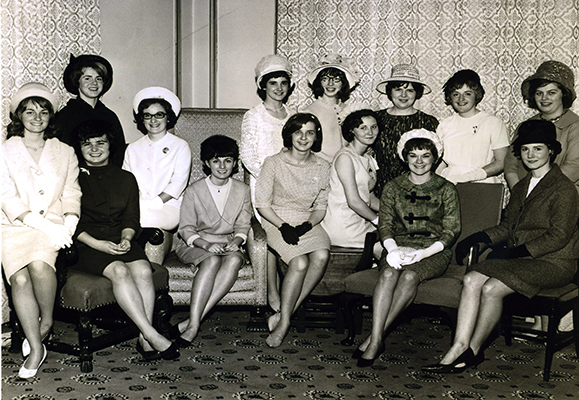
The physiotherapy graduates of the class of 1965 celebrate in style with an honourary tea party.
The invitation read: The pleasure of your company is requested on Sunday, April 25, 1965 at 3:00 o’clock at the Georgian Room, Lord Nelson Hotel on the occasion of the CPA, Halifax Branch Tea for the first graduates of the Dalhousie School of Physiotherapy. And so they came, attired in dresses, high heels, and wearing hats suited to a ‘tea’. As evidenced in the photo, they enjoyed the event--described by graduate, Joan Leng, as a ‘lovely affair’. Within a month, they graduated. Joan remembered that everyone ‘felt proud’ to be part of the inaugural class of physiotherapists. The broad smiles on their faces and the pride on graduation day were gauges of their joy and perhaps, their relief. After all, the Class of 1965 was on a test drive for this new School and Joan and her peers felt ‘a fair amount of pressure to do well’. There were other sources of pressure for these students.A day in their life was evidence of time pressure. Classes ran all day Monday to Friday and often on half days on Saturday. Physiotherapy students crisscrossed the south end of Halifax from the Camp Hill Hospital on Robie (practical classes), to the Forrest Building (Anatomy, Physiology), to the Main campus (Psychology), to the YMCA on South Street (pool therapy), and—for the many who lived in residence—home to Shirreff Hall at the end of the day. A year in their life was evidence of academic pressure. For example, the curriculum was untested. From my administrative perspective, I am certain there were glitches unseen by the class. From their perspective, the curriculum was packed into 20 months with few breaks.
And, there were few avenues to keep the pressure in check. As the first class, students in the Class of 1965 had no ‘upperclassmen’ to consult, no ‘big sister’ to turn to for advice. It is not clear from talking with class members if there was even a mechanism in place for student complaints or appeals. A final source of pressure for students related to their financial sponsorship via hospital bursaries. In return for these investments in their education, students signed two year return-of-service agreements with their sponsoring hospitals. Though I expect these words were never spoken, students likely felt that failure was not an option. Luckily, school was not all work and pressure.
For example, there was a silver lining to those bursaries. They covered tuition, residence fees, and books, as well as providing a living allowance. Another upside: Students did not have to travel for their first clinical placements at the end of year one since they took place in Halifax hospitals, such as the Victoria General, the Grace, Stadacona, the Nova Scotia Rehabilitation Center, and the original Halifax Infirmary, to name a few. I am also assured they had time for fun, including Dalhousie events like Winter Carnival. Since there was no after-hours access to buildings, many practiced their clinical skills on each other at Shirreff Hall. If I know physiotherapy students, fun and food were also on tap during study sessions.
My discussions with class members have left me with two strong impressions: The first is their deep sense of camaraderie. The second is their pride of being first, of charting new territory and succeeding. Both were still evident when they held their 45th anniversary alumni reunion in 2010. They were delighted to be joined by the late Dr. Arthur Shears, a School founder / advocate and one of their lecturers in Physical Rehabilitation. Dr. Shear’s wife, Dotty also held a special spot for the class: She hosted them at the Shears’ home for yet another graduation tea in 1965.
Congratulations to the Class of 1965 for your persistence as students in the first class, for setting the tone of a strong study ethic, for being effective role models for future clinicians, and for your leadership as alumni. We admire you. We thank you. Tea anyone?
- Anne Fenety, Assistant Professor & Director of the School of Physiotherapy