
Spring 2024 Community News
posted by Lil Crump
Meet Kyla and Holly
Holly Carhart and Kyla Brown are physiotherapy clinical instructors committed to supporting students in becoming future healthcare leaders. Learn about their passion and approach as they share the challenges, rewards and importance of clinical instruction for Atlantic Canadian MScPT students.
Holly Carhart is from Sussex, New Brunswick she graduated from Dal's physiotherapy program in 2004.
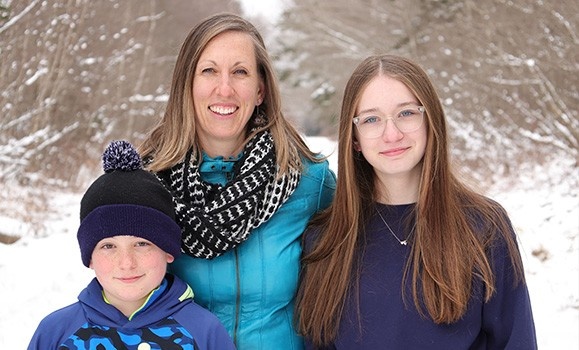
Holly Carhart with children Cameron and Leah
Kyla Brown is Halifax Nova Scotia, she is a graduated from Dal's physiotherapy program in 2002.

Kyla Brown
What is your area of clinical practice in the field of physiotherapy?
Kyla: I have worked exclusively in the Nova Scotia Health Authority since my graduation in 2002. During the course of my career I have worked in everything from ICU settings to tertiary rehab. I have had terms on oncology services, and multiple medicine and surgical floors. However, I fell in love long ago with both acute care and the neurological patient population. So the majority of my career has seen me practicing on our Acute Neurology and Stroke Unit at the Halifax Infirmary.
Holly: I have been working in an out-patient Geriatric clinic for the last 9 years, previously having covered various in-patient hospital units. Geriatrics is my favorite field of practice as it focuses on addressing the specific needs of each unique patient. This can include mobility improvement, fall prevention, pain management, rehabilitation following an acute medical issue/surgery, balance/strength/and vestibular training, as well as the overall enhancement of their functional abilities to maintain independence and quality of life. I find they are one of the most gracious and thankful populations to work with, which contributes to truly loving my job.
What motivated you to be a clinical instructor for students in Dal's MScPT program?
Holly: Students have historically been offered several placements at the Moncton Hospital; thus, I had my first student two years after I started working here. I have continued to offer placements, taking students wherever I worked when placements were requested.
Kyla: I do not remember when being a clinical instructor was not simply a vital part of my practice. I have long since lost track of the number of students I have worked with. While most have come from Dalhousie, I have had students from McMaster, USask, Queens, and even Glasgow, Scotland.
I continue to offer these placements because few true neurological placements are available to students. While there are many areas of practice where you will encounter some neurological conditions, placements, where everyone you see is admitted for neurological conditions, allow you to immerse yourself in understanding and working with the population.
There is such a high expectation on students upon graduating to be able to know how to treat whatever patient or client is in front of them. Getting the hands-on experience that you cannot receive from books is key. Having more exposure to more patients leads to the confidence that they need to approach the next case with solid clinical reasoning. Being willing to offer these placements means that there will be more graduates who will not be intimidated by neurological clients they encounter whether they continue in this field or not.
What aspects of being a clinical instructor do you enjoy the most?
Kyla: I am a lifelong lover of both learning and teaching. My mother was a teacher and helped foster my enjoyment of sharing knowledge. I truly enjoy helping students make a real connection to what they have learned in theory. To understand how lesion localization or the pathophysiology of a condition influences the treatment decisions we make and why. There is nothing like watching a student have an “Aha” moment when something you say, or a real life example you demonstrate makes it all finally make sense.
Holly: I enjoy the opportunity to mentor and guide students as they develop their skills and knowledge in the real-world healthcare setting. I also appreciate the chance to stay up to date on current practices and research. I remember how important placements were for me as a student, many of my clinical instructors having had a significant impact on who I now am as a physiotherapist. It is very rewarding to provide my students with a supportive fostering environment for learning, while watching them grow on their journey to becoming competent healthcare professionals.
Have you come across any challenges as a clinical instructor and if so how where you able to overcome them?
Holly: The biggest challenge earlier on was balancing my clinical responsibilities with teaching duties, managing each student’s unique learning styles and abilities, and addressing unexpected situations that would inevitably arise while ensuring effective communication and collaboration among everyone involved in the patient’s care team. The best strategy I have used for the last few years was keeping my schedule flexible and open for the first few weeks of their placement.
Kyla: Honestly, the most challenging part of having students is finding the balance between providing best practice care to patients, and the best educational opportunity for the students. The most crucial part of this balance being successful is students believing in my sincere wish to meet both of these goals.
Over the years, I have developed a welcome letter they receive before the placement begins that introduces them to the unit and the importance of maintaining best practices even when student learners are present. It also sets up the expectation that the placement is as good as what they strive to make out of it. I expect that any student takes ownership of their own learning experience. We discuss learning needs and comfort levels. This allows me to develop a graduated approach to them getting hands-on experience while I’m still acting as a primary therapist to ensure treatment continues and patients get all they need. Students gradually accumulate their own caseloads as the new patients get assessed over the placement. They also create a list of topics they must review in separate sessions. I set aside time at the end of each day for an education session or just a recap of what we accomplished and what we need to plan for tomorrow. As their comfort improves, they take on increasingly independent roles. By the end of the placement, they carry the caseload with minimal supervision, and the patient care continues.
I understand you are a champion of the 2:1 placement offer. Can you explain how that works and what works particularly well about that type of clinical instruction?
Kyla: I started offering 2:1 placements primarily due to feeling responsible for providing good neurological learning opportunities to students. I truly enjoy the population of patients I treat and am privileged in the wonderful collaborative team I work with. It is an opportunity worth sharing.
I have found that the 2:1 ratio works well for me. First, it allows them to discuss patient plans and bounce ideas off each other. Secondly, a large part of my caseload requires two persons to safely mobilize. What I know of my own failings is that if I am in the room with a patient, it is very hard for me not to take a primary role and very hard for students not to let me. With two students, each can take the primary role for half of the caseload, and the other student can act as their second when needed. This allows me to truly provide some independence and space while supervising and offering advice rather than leading the care. The third advantage of the 2:1 is that on a busy acute care floor, it helps in managing the caseload more efficiently, so there are more opportunities for education sessions as we continue through the placement.
Holly: Early in the pandemic, there was a request for further student placements, so I offered to have students for back-to-back placements. The following year, I decided to offer a 2:1 placement. Given it was successful, I opted to continue offering it since. The key to making it successful is appropriate scheduling and consistent communication, realizing that the students vary in their learning styles/comfort levels, have different prior placement experiences, and require different levels of supervision and feedback. Both of my students carry their individual caseloads, so I was more available for questions/feedback compared to trying to continue with my own caseload. The other benefit for the students is that they can regularly bring questions to each other and assess/treat some patients together, both of which foster their learning.
Do you find volunteering as a clinical instructor helps with your professional development? If so, how?
Holly: Yes, volunteering as a clinical instructor significantly contributes to my professional development. It provides me with opportunities to refine teaching and communication skills, enhance clinical reasoning abilities, ensure that I remain a critical thinker with each of my patients, and stay up to date on the latest research and advancements in our field. It also fosters leadership skills, which improves my ability to complete my other role as one of the supervisors in our department.
Kyla: One of the things I love about where I practice is that there is always some challenge. The general neurology service often has cases coming in without a clear diagnosis, and even after 22 years of practicing, I still come across conditions I have never encountered before. We are all lifelong learners. Students keep me honest. Having to state your clinical reasoning, explain your thought process, and break down the differential diagnoses aloud to students forces you to reflect on the decisions you make. Having students discuss the research they learn about in class keeps me looking forward to keeping my practice current.
Can you share your most memorable clinical instructor experience and why it resonates with you?
Kyla: Assessing and treating neurological patients is not always intuitive to students. At times, students begin the placement overwhelmed and unsure. My job is to break down the parts of the assessment or treatment so that they finally make sense to them. Then, they can start building up confidence in their skills and understanding.
One such student, for her very first assessment, had a stroke patient who was globally aphasic, confused, and physically agitated during the session. She felt totally out of her depth. Our potential for success sometimes has more to do with tone, approach, and body language. She put a lot of time and energy into setting up a relationship, providing consistency in approach and expectation for the treatment sessions. By the end of the placement, the patient’s eyes would light up when she came to see him, and her response was a genuine smile. Learning to build that successful therapeutic relationship in some of the hardest circumstances is a difficult clinical skill that I was so proud to share.
Holly: There honestly isn’t one specific situation that has been the most memorable, as every student has been unique. On the whole, near the end of their placements, each of my students has had a significant improvement in their confidence in problem-solving through their re/assessments to determine the most appropriate goals/plans for their unique patients. The students consistently improve their critical thinking skills when they discuss specific patients with me, highlighting the impact of my teaching and the support I’ve provided them over their placement.
Why do you think it’s important for physiotherapists to help train future PTs?
Holly: Well-trained physiotherapists are essential for providing a high standard and quality care to our patients. My impact on their training helps ensure that their future patients receive competent and effective treatments. There is a huge learning curve from academic knowledge to practical knowledge/skills in healthcare. I realize that the work experience physiotherapists gain over their careers isn’t something that can be taught in school. The hospital system has encountered a “staffing crisis” over the last few years. Training future physiotherapists helps address this demand by preparing them to enter the workforce and contribute to meeting healthcare needs. I feel I have a professional responsibility to educate and mentor future physiotherapists, contributing to our profession's sustainability.
Kyla: Providing placements is viewed as time and energy-intensive by many, and it is if you are doing it right. It is undeniably vital to the growth of physiotherapy students to create those clinical opportunities that allow everything they have learned to “click.” However, whenever I teach and help them make those connections, I share my love for my patient population. Maybe this will inspire them, but I know it renews for me why I love working with and teaching about my acute neurological population.