
Winter 2015 Community News
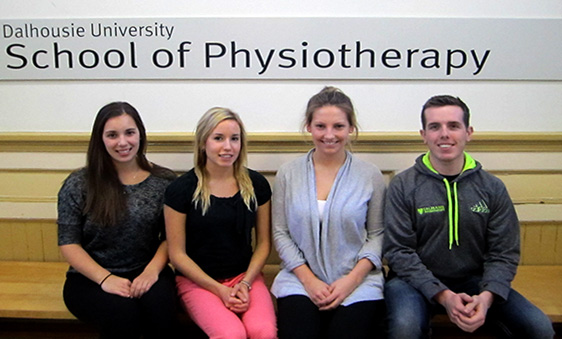
First and second year PT students, Josee Michaud, Skye Fisher, Chelsea Darrach and Stephen Keefe co-presented "Exercise is Medicine," Medicine's Skills Night.
By: Jocelyn Adams, Communications & Special Projects Assistant
What if exercise could solve one of the greatest public health problems of the 21st century? For Dalhousie physiotherapy students this is a reality. In November 2014, physiotherapy students, faculty and local exercise physiologists hosted the Dalhousie Medical School’s Skills Night on the use of Exercise is Medicine ®.
In 2007, Exercise is Medicine ®, also known as EIM, was co-launched by the American Medical Association and the American College of Sport Medicine with the initial purpose of scientifically proving the benefits of physical activity.
Promoting EIM is new to Dalhousie University. This is the first Exercise is Medicine training session at Dalhousie University, with the exception of a presentation last year by Dr. Jonathan Fowls, an exercise physiology professor at Acadia University who is an advocate of the topic and a specialist in Type II Diabetes.
Second year physiotherapy student, Stephen Keefe is a leader behind the Exercise is Medicine ® initiative at Dalhousie. Keefe learned about the multinational initiative following a summer workshop in Charlottetown by Dr. Fowls.
“EIM promotes exercise as a prescription, as a primary form of medicine or care. As physiotherapists, kinesiologists and trainers, we already do this but we’re trying to get everyone else on the same page,” said Keefe.
The Skills Night opened with presentations by Dr. Gail Dechman, Assistant Professor at the School of Physiotherapy, followed by exercise physiologists Jeffery Zahavich and Ashley Zahavich from Kinesio Sport Lab.
The second half of the session presented medical students with the opportunity to cover several case study tutorials.
“We generated discussion with the medical students. We asked the medical students questions, such as ‘what do you think would be the barriers for this person to exercise? What mode of exercise would you suggest’,” said second year physiotherapy student Skye Fisher.
According to Keefe, among time, money and lack of knowledge, one of the biggest challenges is appropriate exercise dosage. “People will say ‘go exercise’ but to somebody that has a chronic disease, the broad term ‘exercise’ can be scary, leading to a lack of physical inactivity.”
“We talked a lot about finding exercises that are manageable for the patient. In two of the tutorials we talked about the stages of change and whether the person is ready to exercise,” said Fisher.
Physiotherapy students recommend collaborative learning with medical students before they practice. “This type of training would be better for students, when you have the time, so that you can prescribe exercise as medicine once you start working,” said first year physiotherapy student Chelsea Darrach.
“First, we want healthcare professions to be aware of the benefits from exercise and how recommending exercise over prescription drugs can offer a lot of the same benefits, if not more, without the side effects from drugs. Secondly, we want physicians to understand physiotherapists, to know what we can offer and know when they can refer patients to us,” said Fisher.