
Spring 2015 Clinical Education Update
By: Jocelyn Adams, Communications & Special Project Assistant
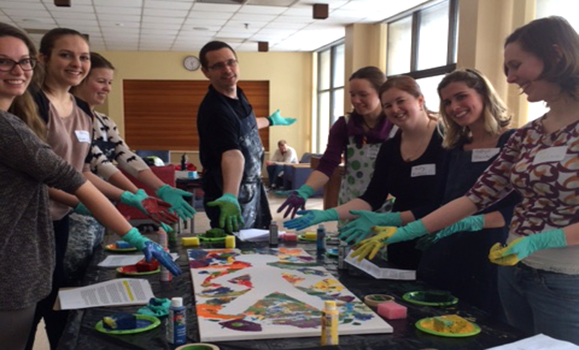
In early 2015, second year physiotherapy students teamed up with students across various health professions to collaborate in an artistic presentation on patients moving through rehab during a neuro placement at the Nova Scotia Rehabilitation Centre (NSRC).
Each Friday, NSRC physiotherapist, Alison McDonald led students from physiotherapy, nursing, social work, occupational therapy, orthotics, speech language pathology and recreational therapy in a multifaceted learning experience. Together, the group created an artistic project expressing their interprofessional experiences of working with patients moving through Acquired Brain Injuries rehab continuum of care.
In the project’s initial stages, students from each profession shared their own case studies. At each stage, students detailed the patient’s challenges and for each challenge they explored how their profession could help.
The project evolved into an artistic expression of a patient’s journey at the NSRC. On the final day of placement, administrators, clinical instructors, faculty and staff were invited for the students’ collaborative presentation. With an artistic tool in hand, students from all professions stood around a table with each profession assigned a separate colour of paint. When a profession could assist with one of the patient’s challenges, a student would describe how they could help then add a splash of paint to one of three canvases. The colours of each profession and the patient began to intermingle. In the end, the canvases were filled with a sea of colours representing how the Acquired Brain Injury team and the patient worked together across the continuum of care.
The project provided second physiotherapy students, Kathryn Garland, Holly (Gallant) Webber and Douglas Vincent with an engaging learning experience.
"It really gave people a better appreciation for how many individuals are involved in the rehab of a patient following a neurological event. Often times we isolate our focus to the individual roles of health professionals when sometimes its nice to step back and look at the entire team," said Garland.
“This was a fun project that allowed team collaboration. It was a chance to explore the roles of other healthcare professions,” said Webber.
“It symbolized our own coming together as students from different backgrounds and learning from each other. The case study reflected experiences we’d all had in providing care for people recovering from stroke. Working together led us to far more insights into how to provide the best care than we could have gotten working alone,” said Vincent.
The group’s artistic creation sparked a lot of attention at the NSRC. “We received a lot of compliments about our project. There was a strong desire to hang the work somewhere in the rehab centre for patients to enjoy it and for staff to use as a teaching tool to explain the continuum of care to patients, said Vincent.
The presentation closed with a final quote from the patient’s perspective of his journey at the Nova Scotia Rehabilitation Centre,
“The gravity of the situation pulls in a host of people devoted to establishing a new orbit of you and your family. So many came together to help me – and each one has left his or her trace across the canvas of my life.”