
Spring 2023 Alumni Profile
Mentor a Student

Clinical experience is an integral component of student education in the School of Physiotherapy. Our current programming requires more opportunities in student placements to meet society's increased health care needs. Connect with our Clinical Education Team at ptclined@dal.ca to see how you can assist in molding the future of physiotherapy.
Q & A with alumna Jennifer Shears
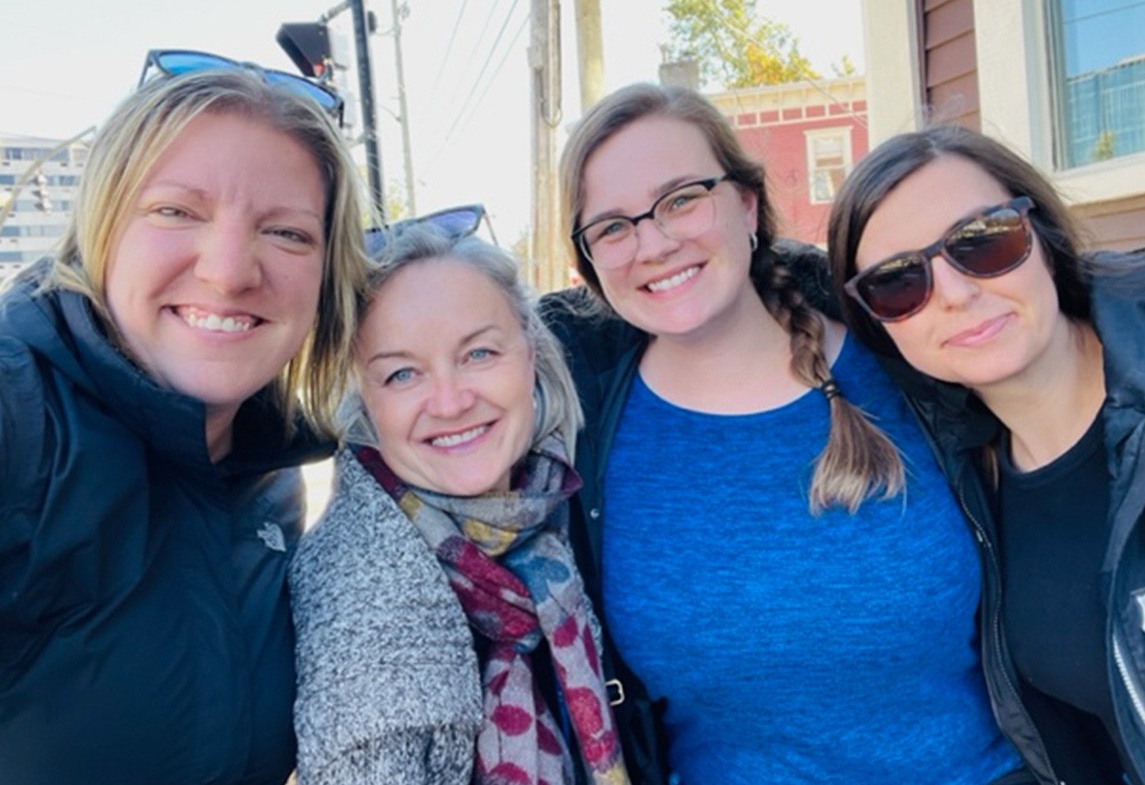
Interviewed by Lil CrumpPhoto: Mallory Peacock, Jennifer Shears, Ashley MacDonald and Sarah Dillon.
Student mentoring allows you to create a network of invaluable colleagues you will have for the rest of your career.
Jennifer Shears, or “Bay Girl” as she has become known by some of her colleagues, is a Dalhousie School of Physiotherapy graduate of the Class of 1995.
Jennifer started her PT career with the Health Corporation of St. John’s and following a year of work in the sunshine state of Florida, resumed her career with Eastern Health where she remains to this day. When not knitting, crocheting, or hanging out with her husband in an old Salt Box home in a rural community outside St John’s (aka “Happy place”), Jennifer fulfills her role as clinical leader for Physiotherapy with the Rehabilitation, Palliative Care and Geriatrics Program, Miller Center Site in St. John’s, NL. I recently had the opportunity to ask Jennifer a few questions about her thoughts pertaining to the field of physiotherapy.
What is the most interesting aspect of the field of physiotherapy for you?
The patients are wonderful, and I love the work we do to help them recover after a life-changing event. In addition, for me, the students!! Having Dalhousie physiotherapy students involved in our program keeps me excited to be a physiotherapist!
You mentioned you completed a MSc Medicine in Neuroscience degree in 2018 –what influenced you to specialize in the neuro aspect of physiotherapy?
While in Florida, I was working on a rehabilitation unit in a small hospital. I had the privilege of working with an inter-disciplinary team specialized in working with a variety of neurological and orthopedic conditions. My interest quickly honed-in on those patients who had suffered from strokes specifically. As a new, inexperienced clinician, I quickly realized I didn’t have enough skilled knowledge and hands-on skills in my “toolbox” to achieve the outcomes they deserved. I did some research as to what education was available for stroke rehab and was lucky enough to be accepted into the Rehabilitation Institute of Chicago (now the Shirley Ryan Ability Lab) where I completed my introductory course in Neuro-Developmental Theory (NDT). This course changed my practice. I returned home later that year and started to work with Dr. Michelle Ploughman who was, at that time, the clinical leader for physiotherapy at the Miller Center. The rest is history. My life’s work has been in the neurological field.
You mentioned that students play a role in keeping you excited about the field of physiotherapy. Why is that?
I discovered how much I loved to share my passion and knowledge with up-and-coming PTs from the very first student that I mentored. Watching them evolve from novice to entry-level practitioner is a very rewarding experience. The energy and enthusiasm students bring to the clinic is contagious! They keep you up to date, on your toes and relevant. They also encourage you to remain evidence informed. Student mentoring allows you to create a network of invaluable colleagues you will have for the rest of your career.
How long have you been involving students in your program?
I’ve taken students since quite early in my career. I believe 24-25 years. I’m thinking more than 17 students for sure.
Have you encountered any challenges when working with students?
I believe working with people in general can be challenging. It doesn’t matter if they are students or seasoned clinicians. It is true that some students are more challenging to teach. It may mean finding out how to overcome the obstacles to their learning or it may require reflecting on your own style of teaching to determine if it needs to change to become more effective – for me, the challenge makes it intriguing.
Do you have some tips for Clinicians who are new to student mentoring?
It's important to get to know your student well, right from the start. Building a trusting relationship is key. Some students need more attention than others - it takes patience and understanding on our part. Clinicians are busy, but I think if they remember how it was for them during their learning process, it’s easier to find the empathy for a struggling student.
Recent years haven’t been kind to students. The stresses of having to learn from home, online vs. with your peers in-person at school, or with peers in the clinical setting have resulted in a steeper learning curve for them. We need to acknowledge this and support them as they will soon be our colleagues. We too, have had many challenges to deal with as clinicians throughout the pandemic in a struggling healthcare system and work – life balance. Life moves forward and we need to work towards a “new normal.”
What advice would you give to our students as they prep for their clinical placements?
The most important thing a student should know when they are on clinical placements is that they are part of a team. It’s their opportunity to bring all the theory into practice. It can be challenging at first and it’s normal to be a bit nervous. Most students quickly realize how valuable this experience is and see how effective their input is. Students aren’t meant to “know it all!” - no one does. Physiotherapists are life-long learners!
Any final thoughts you would like to share with the physiotherapy community?
I would recommend preceptors offer placements for Dal PT students. The more opportunities we provide to our students in their home province the more likely they will return following their graduation from Dalhousie.
We need more PTs in the community. I’d love to see more interdisciplinary teams based in the community and hopefully this will evolve.
Physiotherapy is a very dynamic discipline with very skilled clinicians, and I believe we have the ability to move mountains!! Our students and future PTs will carry us into the future given the opportunity to have the experience. Let’s give this to them!