
Major Marsha MacRae
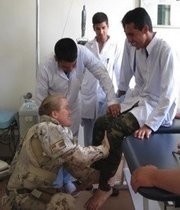
Major Marsha MacRae working with some of the students in the physical therapy technician class at the Afghan National Army’s Armed Forces Academy of Medical Sciences.
Education
- BSc(PT) (Dal), 1995
- MSc(RRPT) (Dal), 2011
Working as a Physical Therapy Mentor in Kabul, Afghanistan
As a Physical Therapy Officer for the Canadian Armed Forces, Major Marsh MacRae recently had the opportunity to deploy for six months as part of the Canadian Contribution Training Mission –Afghanistan.
Across Canada, many of us have grown to consider rehabilitation services a necessary agent in injury prevention, rehabilitation and health promotion. Our Canadian Armed Forces also benefit greatly from these services where 36 military physical therapists are currently employed. Citizens and military personal of other countries are not so fortunate. In Afghanistan, these services are still very much in the early stages of development due in part to the challenges of the last three decades including constant physical threats, issues of poverty and decreased access to education. There are slightly more than 200 registered physical therapists in Afghanistan (population 29 million). Within the Afghan National Army’s (ANA), there are no trained physical therapists. The role of rehabilitation falls to the physical therapy technicians located either within Kabul or one of four regional areas throughout Afghanistan.
This environment places special emphasis on the need for practically trained physical therapy technicians. While in Afghanistan, Marsha was responsible for providing mentorship to the Afghan National Army’s Armed Forces Academy of Medical Sciences (AFAMS) in the training and development of the first class of physical therapy technicians. Although there is one civilian institute within the country that trains physical therapists, the ANA trains many of its own medical personnel including nurses, dentists, and a variety of technicians to ensure the provision of medical services specializing in a broad range of combat injuries.
In Marsha’s advisory capacity, she had the opportunity to collaboratively work with the ANA’s physical therapy technician program heads and Canadian Armed Forces Training Development Officers to support leadership and physical therapy technician training development. Multiple weekly trips outside the security of the military compound to the ANA’s National Military Hospital, Polyclinic and AFAMS were used to establish the ANA’s needs and current capabilities for physical rehabilitation. Once established, recommendations for program changes, and the creation and implementation of collaboratively established job descriptions and qualification standards were completed.
Marsha found it difficult to see significant and lasting changes over the course of a mere six months, yet had a wonderful feeling knowing that through the collaborative efforts of the Afghan and Canadian teams, both the students and future patients were better positioned for success. Perhaps the most rewarding aspect of her time in Afghanistan was teaching both instructors and students various aspects of physical therapy, including the basics of clinical reasoning and low tech and sustainable assessment and treatment techniques. In the end, Marsha felt a true honor and privilege to serve with such a dedicated and deserving group of students and future ANA leaders.