
News
» Go to news mainA Shift in Energy

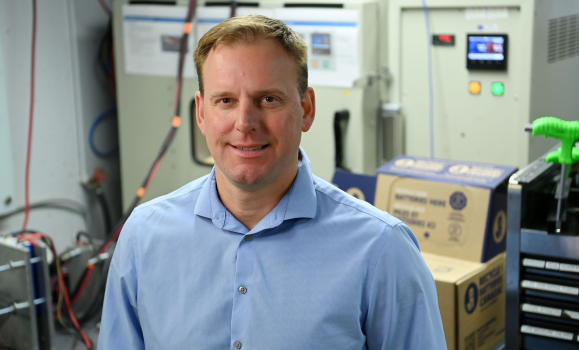
If you had asked Dr. Lukas Swan five years ago what he would be working on today, he never would have said sodium-ion batteries or Nova Scotia’s offshore wind future. Yet here he is, leading a groundbreaking project that could redefine how the province harnesses and stores renewable energy.
A long-time electrification expert, Swan has spent decades championing a system where wind and solar power homes, buildings, and charge electric vehicles, with the excess energy being stored in batteries for later use.
“I remember people laughing at me 15 and 20 years ago, saying, ‘Natural gas is cheap, or oil will become cheaper, or let's burn wood instead because we have lots of trees,’” he says. “And now people are buying electric vehicles like hotcakes, and virtually all new communities are being built with heat pumps.”
Things are changing again. Swan is now turning his expertise toward sodium-ion batteries, a chemistry he has never worked with before. And he’s exploring how it could complement or even surpass in some ways lithium-ion for stationary energy storage.
Powering the Future
Funded through the Canada First Research Excellence Fund (CFREF), the seven-year, $1023-million Voltage (VOLT-AGE) grant unites universities, government agencies, industry, and indigenous partners to explore electrification, including batteries. Unlike lithium-ion, sodium-ion batteries use abundant, lower-cost materials and are ideal for stationary applications like grid storage, where size and weight matter less than in mobile application like cars or phones.
Starting with a seed grant just over a year ago, Swan dove headfirst into sodium-ion. “We’re learning as we go,” he says. “We’re running into problems, finding solutions, trying different techniques.”
The research quickly expanded, bringing on PhD and undergraduate students and giving them hands-on experience with partners ranging from Canadian and U.S. companies to defense organizations, Indigenous groups, and public agencies.
To kick things off, the lab invested about $30,000 in cells, from thumb-sized cylinders to shoebox-sized prismatic modules and began cycling them through rigorous tests of temperature range, voltage range, and real-world load simulations. Their goal: to design modules and packs for stationary storage, powering everything from homes to commercial buildings and the wider electricity grid.
Swan isn’t working alone, he’s also teaming up with experts at the universities Concordia, Calgary, ETS Montreal, and Carleton, including Faculties of Engineering, Science, and Social Science.
For students, it’s a front-row seat to the future of energy. Over the next four years, about 23 PhD students will dive into the project, tackling new technologies and collaborating with partners across North America. “It's allowing them to go off and do their individual PhD research tasks, but recognizing this web of interlinks between sciences and engineering and social science, and drawing them back together to share and collaborate” explains Swan.
Perfect Timing
The timing couldn’t be better. With Nova Scotia ramping up onshore wind and solar, and making major commitments to offshore wind, current electrical grids may not be ready for all that extra power.
“We do battery research because we need to store energy,” says Swan. “These sodium-ion batteries are exclusive for stationary. That’s our focus. We need to store wind and solar energy when there’s excess, and release it at later points when the sun goes down, when the wind stops blowing, or when the temperature drops and the heat pumps come on.”
He adds that while Asia leads in sodium-ion production, and Europe and China dominate offshore wind, Nova Scotia offers unique advantages: abundant land, strong winds, and a chance to develop domestic battery supply.
“Five years ago, I wouldn’t have imagined working on offshore wind and sodium-ion batteries. But that’s where I am. We’re pivoting fast, filling research gaps, and doing work that’s critical for the province of Nova Scotia and the region as a whole,” he says.
With this work, Dalhousie Engineering is emerging as a hub for renewable energy research. While the rest of the world has valuable expertise, Swan says their technologies may not be suited for the province’s unique conditions.
“Although the Europeans have done a phenomenal job and the Chinese now lead at this point in offshore wind energy, they have not seen a resource like we have here in Nova Scotia,” he says. “Our winds are just substantially stronger, and you really need boots on the ground and local research. That’s where the fun is for us in our research work.”
Recent News
- A Shift in Energy
- Dal Engineering grad builds a better way to find a roommate
- Faculty of Engineering’s new Indigenous Pathways Program Coordinator Pays It Forward
- How Two PhD Students Are Powering Nova Scotia’s Tidal Future
- How the Faculty of Engineering’s Annual Golf Tournament Helps Bring Student Ideas to Life
- Meet the Team behind the Jumpsuits: How the Dalhousie Engineering Gearheads are making an impact
- Celebrating 90 years of Dr. Dhandapani Thirumurthi
- From Wind to Sun to Steady Power