
News
» Go to news mainFrom Wind to Sun to Steady Power

Although wind and solar energy are essential to a cleaner future, they are not always reliable. Traditional power grids were designed for steady, predictable energy sources like coal, gas, or hydro. Wind and solar behave differently. For example, the wind doesn’t blow on demand, and the sun doesn’t always shine on schedule.
Unfortunately, electrical grids have to provide a constant, dependable flow of power to homes, businesses, and essential services every day. This has been one of the biggest challenges facing modern power grids.
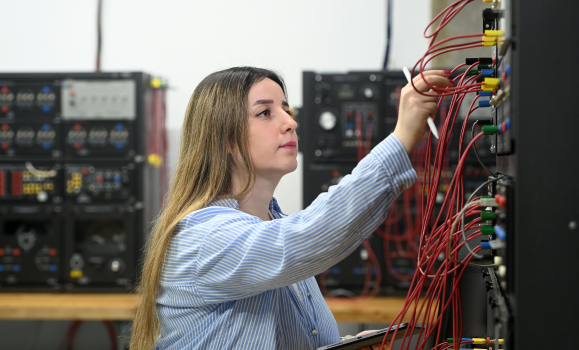
A PhD student in electrical engineering at Dalhousie University, Mehrnaz Ahmadi, is focused on solving that problem by exploring how to make renewable energy more reliable.
Forecasting Power
One part of her work focuses on forecasting wind power, a difficult task because renewable energy data can be noisy and unpredictable.
“So when we want to forecast them, it’s really hard,” she explains. “First, we need some signal processing to reduce the noise from the original data. Then we use different machine learning and deep learning methods to improve the prediction accuracy.”
Another major part of her research looks at what happens in real time, when renewable energy suddenly drops or surges. When that occurs, different pieces of grid equipment, such as transformers, energy storage systems, and electronic controls, need to respond quickly and in coordination.
“The voltage becomes much more volatile,” she says, which makes managing the system far more complex. To address this, she uses artificial intelligence that allows different parts of the grid to “communicate” and make smart decisions on their own. By dividing the grid into regions, these intelligent systems can respond locally while still working together to keep the overall system stable and reduce operating costs.
Practical Data
To conduct her research, Mehrnaz has access to operational data from Nova Scotia as part of a Net Zero Atlantic-funded project in collaboration with EverWind, a Canadian company leading the development of North America's first large-scale green hydrogen and green ammonia projects.
“Grid decisions have real consequences,” she says. “Having access to Nova Scotia’s operational data grounds the research in local needs, helping us to design tools that improve stability and cut operating costs.”
This work directly supports Nova Scotia’s and Canada’s long-term climate goals. As governments push toward deep decarbonization and net-zero emissions by 2050, utilities need to find ways to integrate renewables at scale without sacrificing reliability or affordability.
Early Interest
Mahrnaz’s interest in renewable energy began early. As an undergraduate student in her home country of Iran, she was drawn to the challenge of integrating renewables into power systems. But she wanted to work in a place where renewable potential is high and the push toward net-zero is urgent, conditions that make reliable, grid-scale solutions essential.
Two years ago, she moved to Canada to start her second PhD at Dalhousie. She says she was drawn to the university’s strong research reputation and its focus on hands-on, practical problem-solving.
Adjusting to a new country was a challenge, but having her husband already in Halifax made the move much easier. She was also struck by how welcoming everyone was.
“People here are really supportive and respectful, and it’s easy to feel included,” she explains. “I’ve really come to appreciate the culture, Nova Scotia, and the university, the community makes you feel at home while you’re building something new.”
Promising Results
With hopes of completing her PhD by the end of this year, she says her research so far has shown very promising results. Her models demonstrate improved grid stability, better use of renewable energy, and lower system costs.
“I’m really interested because it’s a practical project, not just theoretical. I’ve been really happy to work on it and share our results through papers and conference presentations, and we’ll continue building on that work moving forward,” she says.
Future Goals
She’s hoping to continue making a positive impact on her community and on future engineering students by pursuing a career in academia, where she can keep advancing renewable energy solutions and mentor a new generation of engineers.
“I’m really happy, especially in Canada, because we have so many renewable resources, like wind, solar, and water,” she says. “Being able to use these sources makes our work really impactful and meaningful.”
Mehrnaz is a researcher in Dr. Hamed Aly's Smart Grid and Green Power Research Laboratory. Dr. Aly is a leading expert in advanced renewable energy integration for modern power systems. His highly interdisciplinary team develops AI-driven and machine learning solutions for smart grid stability, power quality management, and real-time microgrid control. A core focus is the creation and application of digital twin technology to optimize the performance and resilience of energy systems incorporating wind, solar, tidal, and storage resources. Supported by numerous grants from NSERC, Mitacs, NetZero Atlantic, and industry partners, the lab tackles critical challenges in renewable forecasting, harmonic mitigation, electric vehicle grid integration, and the deployment of decentralized, sustainable energy systems for a net-zero future.
Recent News
- Understanding the Water Beneath Our Feet
- A Shift in Energy
- Dal Engineering grad builds a better way to find a roommate
- Faculty of Engineering’s new Indigenous Pathways Program Coordinator Pays It Forward
- How Two PhD Students Are Powering Nova Scotia’s Tidal Future
- How the Faculty of Engineering’s Annual Golf Tournament Helps Bring Student Ideas to Life
- Meet the Team behind the Jumpsuits: How the Dalhousie Engineering Gearheads are making an impact
- Celebrating 90 years of Dr. Dhandapani Thirumurthi