
Fall 2017 Faculty Profile
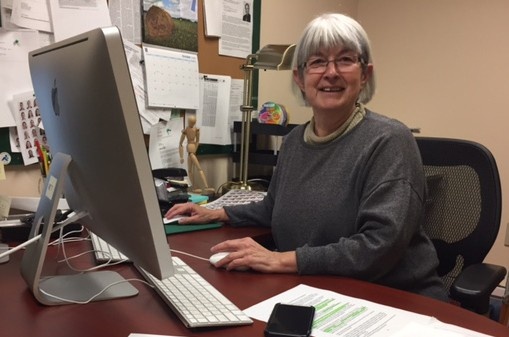
Dr. Sandra Curwin
Associate Professor BSc, MSc, PhD
Each season, Physiotherapy Matters highlights activities and accomplishments of a faculty member from the School of Physiotherapy and how they have impacted the field of Physiotherapy. This fall, we are pleased to profile Dr. Sandra Curwin.
Sandra initially came to Dalhousie University from her hometown of Moncton, New Brunswick, to pursue a degree, majoring in either English or Biology. She didn’t even know what physiotherapy was, but applied “on a whim” based on advisement from a fellow New Brunswicker, Dawn Kilpatrick. Sandra offers, “Because physiotherapy was a 2-year diploma at the time, I decided I would do it, with the thought that I could always go back to English later if I did not like physiotherapy.” Sandra graduated with a physiotherapy diploma in 1976 and never looked back.
In late 1979 Sandra started a private practice (Physiotherapy Atlantic), picking up courses to complete her BScPT at the School of Physiotherapy during this same time. In 1982 Sandra sold her practice and, after taking the summer to study French in Laval, Quebec, Sandra returned to Dalhousie’s School of Physiotherapy to complete the physiotherapy degree process. She took three courses which were required to complete her degree along with two additional courses - British and French Literature. “Unfortunately, my French writing was awful and I didn’t like getting ‘C’ on essays, so I dropped that course after a few weeks and picked up a graduate Biomechanics course instead.” Sandra continues, “I did not know a thing about biomechanics, but I persevered. I ended up liking it so much I did my Master's degree in Biomechanics with Dr. Carol Putnam in the Kinesiology department at Dal.”
Sandra’s physiotherapy interests came into focus throughout her studies and private practice experiences. She began working mainly in the field of sports injuries helping the Nova Scotia branch of the Sports Physiotherapy Division. When working with Dr. Bill Stanish, she saw many people with recalcitrant tendon injuries, which were very resistant to traditional treatment techniques. A medical student, who was also working with Dr. Stanish at the time, had proposed the idea that, perhaps, tendons could be “trained”. After a great deal of brainstorming, the team came up with an exercise program tailored to specific tendon problems. In Sandra’s words, “I spent a lot of time researching the physiology and biomechanics of tendons, and was doing my MSc at the time, which enabled me to do my thesis on calculating loads on the Achilles tendon during the Eccentric Exercise Program on some sports-related movements like running and landing from a jump. I ended up later heading in the biochemistry direction for my PhD at UCLA, because I wanted to know how tendons adapted when they were subjected to increased or decreased loads. I guess you could say tendons are my passion!”
The Eccentric Exercise Program
The eccentric exercise program was established through trial and error. First came the development of the progressive loading program that simulated the movement that created the tendon injury. The theory was, that by gradually increasing the loads on the tendon, it would adapt and become stronger. The theory was tested on with hundreds of patients, until finally the team settled on the system now known as the 'eccentric exercise program' - or EEP.
“As word of EEP spread through papers and conference presentations, we received numerous requests for details, and help with patients. “Sandra shares, “We finally decided to write a book outlining the science behind our approach and explaining how to use it for common sports-related tendon problems like Achilles tendonitis, Tennis Elbow, and Jumper's Knee.”
While completed her MSc in Biomechanics, Sandra continued working with the team to fine-tune the EEP. Her research showed that maximum load on, and length of, the tendon usually coincided - which was what the EEP does clinically. “We were thrilled to have found a way to treat people with 'stubborn' tendinopathies, and our approach has now become the standard approach worldwide for treating people with 'overuse' tendon problems,” Sandra explains with enthusiasm.
Dalhousie Physiotherapy Clinic
When asked about her involvement in the Dalhousie Physiotherapy Clinic, Sandra is quick to offer,
“I have had the dream of starting a clinic associated with the School of Physiotherapy since 1990, and am excited that we are finally getting the opportunity to create a space that will combine clinical practice, teaching and clinical research and enable us to create new approaches and examine our current practices.”
The most exciting part to Sandra is the chance to deliver quality clinical care to our communities, and to conduct clinical research to advance our practice and improve patient care further. Her main job is teaching MScPT students, and the clinic will enable the school to more easily provide clinical teaching opportunities for these students. Collaboration with Dalhousie Athletics, who are also partners in the new clinic, and the Department of Kinesiology in the School of Health and Human Performance, offer the possibility of new models for providing care for Dal's athletes and new opportunities for students to learn how to provide exercise-related programs for people from the wider community with all kinds of physical limitations. Sandra is particularly excited about the opportunity to collaborate with Dalhousie’s
Department of Athletics and Recreation’s Varsity Athletics and Dalplex to provide immediate quality care to any Dalhousie staff, faculty and students who experience a work or recreation related injury.
No Learning is Ever Wasted
What valuable lesson can Sandra offer from her experience in Physiotherapy?
“Anything can be interesting, even tendons, once you know enough about it!” Sandra also advises to be “a bit stubborn when you have a new idea, and believe in that idea for as long as it takes to see it happen – even if it is 27 years.”
Sandra also suggests that more clinicians with research training, and vice versa would be helpful in the field of physiotherapy
Another tip Sandra learned is that if you are keen, and want to know more, there is always someone who will help you, and that you can always learn more and get better at what you do. No learning is ever wasted.
And for a final thought, Sandra notes, “it helps to have other creative, enthusiastic people around - like Dr. William Stanish who supported me so much in my early career, and Dr. Anne Fenety and Tim Maloney, who brought the Dalhousie Physiotherapy Clinic to fruition”.
We, at the School of Physiotherapy, are thankful for Sandra’s creativity, experience and enthusiasm for the part she played in this ambitious project. We are looking forward to celebrating the efforts of all those involved with this initiative at the Dalhousie Physiotherapy Clinic grand opening (stay tuned!).