
Student Research
A BALANCING ACT: OCCUPATIONAL BALANCE AMONG MATURE GRADUATE STUDENTS
Lil Crump with Brittany Bhatnagar
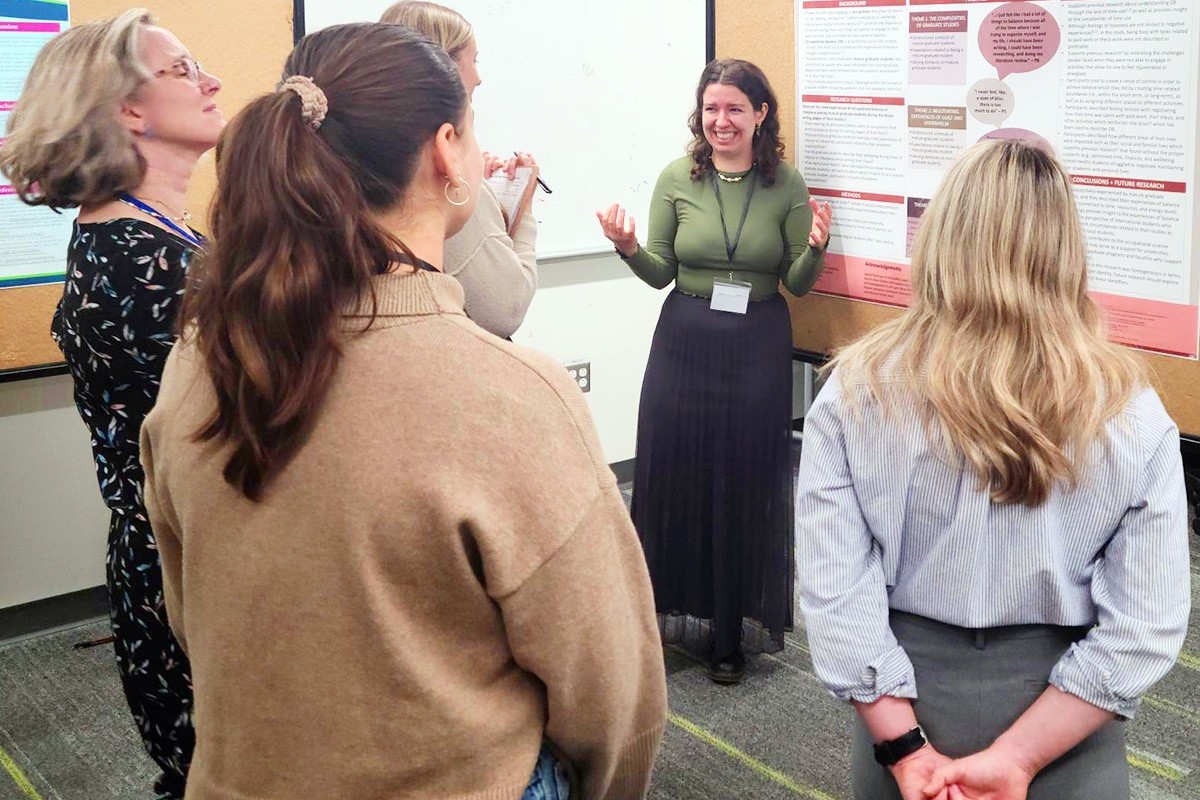
Photo credit: Kimberly Jacobs
During her undergrad degree, Brittany Bhatnagar had the opportunity to collaborate with other disciplines, which led her to pursue the MSc Occupational Science (MScOS) degree. Brittany says the MScOS degree provided her with the perfect opportunity to diversify her background and broaden her understanding of people's everyday actions.
We caught up with Brittany, who presented her poster at the recent Crossroads Conference held here in Halifax. Crossroads is an Interdisciplinary Health Research Conference hosted by the Graduate Student Society of Dalhousie's School of Health and Human Performance—a nationwide peer-reviewed academic conference.
Project Topic
Brittany's project explores the lived experiences of occupational balance among mature graduate students. She gathered data from 8 participants to better understand their experiences of navigating the writing stages of their thesis, other obligations like paid work or volunteering, and their personal lives. Like many, mature graduate students are busy and are in a unique position to organize themselves, given that they often have flexible schedules. Brittany explains that her findings reflect that the context of graduate studies is complex, and it can be challenging for students to feel a sense of balance. Students often felt overwhelmed and guilty about their academic responsibilities, which commonly left little time for activities like leisure, rest, socialization, and tasks related to their homes.
Her findings provided insight into one way participants tried to take back control which describes when they initiated boundaries with where and how their time was being spent, and negotiated feelings of balance within different time frames. Some aimed to re-balance themselves within a shorter time span, and others looked more broadly and aimed to become re-balanced within a longer time span. Overall, Brittany explains that the findings clearly indicate that experiences of occupational balance are subjective. Occupational balance can support well-being by promoting opportunities for people to engage in various meaningful activities. Brittany's research not only contributes to the Occupational Science literature but also may support universities, especially graduate programs with mature students enrolled.
The Inspiration
Brittany comes from a Leisure studies background and has always valued leisure experiences, especially as a means to support well-being. Both from personal experience and observing the world around me, it became clear to Brittany that our population often neglects free time and prioritizes other activities like work tasks. Brittany explains she became interested in exploring academia as the academic environment offers a lot of flexibility regarding how one's time is spent. Overall, she felt like exploring mature graduate students was a good fit for providing more insight into the concept of occupational balance. "I am fascinated with how we spend our time, the meaning we place on these activities, and how these activities may contribute to our sense of self and well-being." Brittany shares. She goes on to say that the Crossroads Conference provided a welcoming and supportive environment that created an excellent space for researchers to share their work. She particularly enjoyed the various research topics involved in the conference this year.
Brittany’s research supervisors are Dr. Heidi Lauckner (School of Occupational Therapy) and Dr. Karen Gallant (School of Health and Human Performance), she graduates from the School of Occupational Therapy's MScOS Program this month. Congratulations Brittany!