
Faculty Feature Fall 2025
Advancing OT education through simulation, collaboration, and innovation
School Professor, Dr. Diane MacKenzie shares her current program of research
I was a clinical occupational therapist for 12 years in stroke and brain injury neurorehabilitation before shifting into the academic and research world at Dalhousie University. My clinical background and subsequent years of teaching continue to drive my curiosity and research program in professional and interprofessional education. It is my firm belief that students require authentic occupational therapy and interprofessional educational (IPE) opportunities in a safe, but competency-based, learning space. Academic preparation needs to be relevant for preparing students to practice competencies in rapidly changing environments.
My research program is informed by my work experience, graduate training in observation science and decision-making (i.e., eye-tracking), and advanced training in health professional/interprofessional curriculum design and simulation. As a result, most of my collaborations and research projects are located at the intersection of these areas. The projects I will highlight here also include several colleagues from Dalhousie's School of Occupational Therapy.
Simulation in occupational therapy education
Simulation is increasingly being used in occupational therapy education and practice, but there are no guidelines for Canadian occupational therapy programs for its use. Since May 2023, I have co-led a national group[1] to complete a three-phase research study to develop guidelines for the use of simulation in academic and fieldwork contexts. School Instructors, Dr. Kaitlin Sibbald and Jonathan Harris, are part of our group, which contains members from 9 Canadian occupational therapy programs. We are looking forward to the launch of the Guidelines at CAOT 2026 in Montreal!
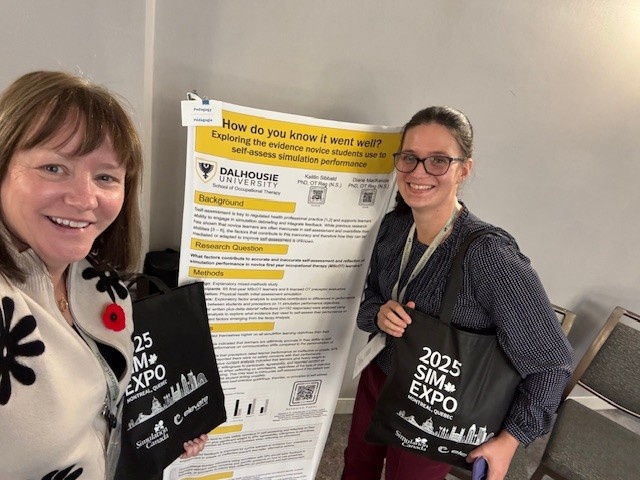
Drs. MacKenzie and Sibbald with presentation poster at the 2025 SIM Expo.
Student perspectives in occupational therapy simulation
As a leader in the use of high-fidelity OT sequential simulations, the work in collaboration with Dr. Kaitlin Sibbald has studied the impact of the novel simulation-based fieldwork preparation course on students’ perceptions of their skills in communication, collaboration, clinical practice, safety awareness, and confidence in fieldwork. Some of our work can be found here:
Sibbald, K. R., & MacKenzie, D. E. (2025). Factors influencing reflection and self-assessment of simulation performance: Comparing student and preceptor ratings. Journal of Occupational Therapy Education, 9 (2). Retrieved from https://encompass.eku.edu/jote/vol9/iss2/8.
Sibbald, K. R., & MacKenzie, D. E. (2024). Evaluating Change in Skill Performance Over Time and Practice Context in Introductory Fieldwork Simulation. Journal of Occupational Therapy Education, 8 (2). Retrieved from https://encompass.eku.edu/jote/vol8/iss2/11.
Sibbald, K. R. & MacKenzie, D. E. (2023). Sequential simulations during introductory part-time fieldwork: Design, implementation, and student satisfaction. Open Journal of Occupational Therapy, 11(3), 1-12. https://doi.org/10.15453/2168-6408.2105.
Sibbald, K. R., MacKenzie, D. E., & Harris, J. (2023). Occupational Therapy Students’ Perceptions of Feedback During Pre-Fieldwork Simulation Debrief: Useful and Why. Journal of Occupational Therapy Education, 7 (1). https://doi.org/10.26681/jote.2023.070113.
Interprofessional education and research
As the School of OT and Faculty of Health IPE Coordinator, I continue to design and evaluate the stroke IPE experience.
The large-scale stroke IPE served as the foundation for an ongoing study funded by the Shoppers Drug Mart Research Collaboration. We are developing new online and interactive modules to support best practice community stroke care with the underserved population of post-menopausal women. Team members from Dal's School of OT include: Dr. Katilin Sibblad (Postdoctoral Fellow on the project), Dr. Sorayya Askari, and Kaarina Valavaara, together with our interprofessional colleagues at Dal and practice leaders in the community.
MacKenzie, D. E., Sibbald, K. R., Sponagle, K., Hickey, E., Creaser, G., Hebert, K., Gubitz, G., Mishra, A., Nicholson, M., & Sarty, G.E. (2024). Developing pre-licensure interprofessional and stroke care competencies through skills-based simulations. Journal of Interprofessional Care, https://doi.org/10.1080/13561820.2024.2371339.
Trail-making Test (TMT) and eye movement in mild traumatic brain injury (mTBI)
An active pilot study (co-investigator Dr. Sorayya Askari) is investigating eye-movement differences between individuals with mTBI and matched controls across three different TMT A and B conditions. The study is the result of a scoping review investigating the merits of eye-tracking to detect cognitive function.
Pearson, H. C., MacKenzie, D. E., Oystreck, D. T., & Westwood, D. A. (2023). Using eye tracking technology to measure cognitive function in mild traumatic brain injury: A scoping review. Journal of Concussion, 7, https://doi.org/10.1177/20597002231194151.
Click the link to learn more about Dr. MacKenzie's research interests.
________________________________________
[1] This is an ad hoc national group under the Academic Education Committee, part of the Association of Canadian Occupational Therapy University Programs (ACOTUP).