
Our History
From SafetyNET-RX to Safe Assured
For two decades, we have worked with community pharmacies to learn from medication incidents and make care safer. The Safe Assured name dates from 2018, but the work began in 2005 as SafetyNET-Rx, a Nova Scotia partnership of pharmacists, regulators and university researchers.
Generated by Gemini AI
Where it began: SafetyNET-Rx (2005–2010)
In 2005, the Nova Scotia College of Pharmacists sponsored a study of quality improvement in community pharmacies. Researchers from St. Francis Xavier University and Dalhousie University worked alongside [about 70] community pharmacists. At the time, most medication-safety research focused on hospitals. Far less was known about what happens in the community pharmacy.
The study grew into SafetyNET-Rx, a provincial research collaboration led by St. Francis Xavier University with the Nova Scotia College of Pharmacists and Dalhousie's College of Pharmacy. Its starting idea was simple: an error or near miss is a chance for the whole pharmacy team to learn, not just a mistake to count.
Participating pharmacies recorded these "quality-related events" through the Community Pharmacy Incident Reporting system (CPhIR) of the Institute for Safe Medication Practices Canada (ISMP Canada). They met regularly to discuss what they reported and completed an annual medication-safety self-assessment.
An early lesson shaped everything that followed. A reporting system on its own was not enough. Pharmacies also needed time to reflect, the whole team involved, and a culture in which staff felt safe to report.
Early funding came from the Canadian Institutes of Health Research, the Social Sciences and Humanities Research Council of Canada, the Nova Scotia Health Research Foundation and the Canadian Foundation for Pharmacy.
A First for Canada! (2010)
In 2010, Nova Scotia became the first province in Canada to require community pharmacies to report medication errors. A research project with volunteer pharmacies became part of province-wide practice. Other provinces, including Ontario, have since introduced their own reporting requirements.
Building the evidence (2010–2017)
Mandatory reporting created a rare, province-wide record of what happens in everyday pharmacy practice. Our 2018 study in CMAJ Open analysed seven years of reports from 301 Nova Scotia community pharmacies, from October 2010 to June 2017:
98,097 quality-related events were reported.
82% were caught before they reached the patient.
Fewer than 1% (928 events) were associated with patient harm.
The most common events were an incorrect dose or frequency, an incorrect quantity, or an incorrect drug, most often at order entry.
The findings drew national media attention and continue to guide quality-improvement work in community pharmacy.
A new name and a wider mission (2014–2018)
Dr. James R. Barker of Dalhousie's Faculty of Management joined SafetyNET-Rx in 2014 to evaluate the program and became its principal investigator in 2017. He brought a focus on organizations, leadership and systems: how pharmacy teams, workflows and policies shape safety.
In 2018, the program was renamed Safe Assured and its home moved to the Rowe School of Business. The new name reflected a national scope and a broader question. Beyond "What went wrong?", we began asking "Why did it happen, and what can change so it is less likely to happen again?"
A national and international consortium (2018–today)
Safe Assured grew into a consortium of researchers from Dalhousie, St. Francis Xavier, Queen's, Saint Mary's, HEC Montréal, the University of Cincinnati and Manchester University (UK), working with Pharmapod, Shoppers Drug Mart and Ontario's AIMS (Assurance and Improvement in Medication Safety) program.
Our research expanded with it:
Data analytics: machine learning, risk mapping and predictive models that look for patterns in incident data.
COVID-19: how the pandemic changed medication incidents and the pressures on pharmacy teams, including medication home delivery.
Resilience: how pharmacies keep medication safe under heavy and changing demands.
Policy and knowledge translation: turning evidence into guidance for regulators, professional bodies and pharmacy leaders.
Today this work is organized into four research pillars, described on our Research page.
Recognition
In 2020, the SafetyNET-Rx research team (James Barker, Neil MacKinnon, Todd Boyle and Bev Zwicker of the Nova Scotia College of Pharmacists) received the Robert L. Wears Patient Safety Leadership Award from the QSEN Institute for Patient Safety. The award recognized work that has shaped pharmacy safety regulation and practice in Nova Scotia and beyond.
Remembering James Barker
Dr. James R. Barker, Research Lead of Safe Assured, died on December 2, 2023. His leadership turned a provincial reporting program into an international research community. [Read our tribute →]
Safe Assured today
Safe Assured continues as a multidisciplinary team, currently co-lead by a leadership team, with expertise in in management, information systems, nursing, pharmacy and public policy, and partners across Canada and internationally. Our purpose is the same one set in 2005: learning from medication-safety events to make care safer.
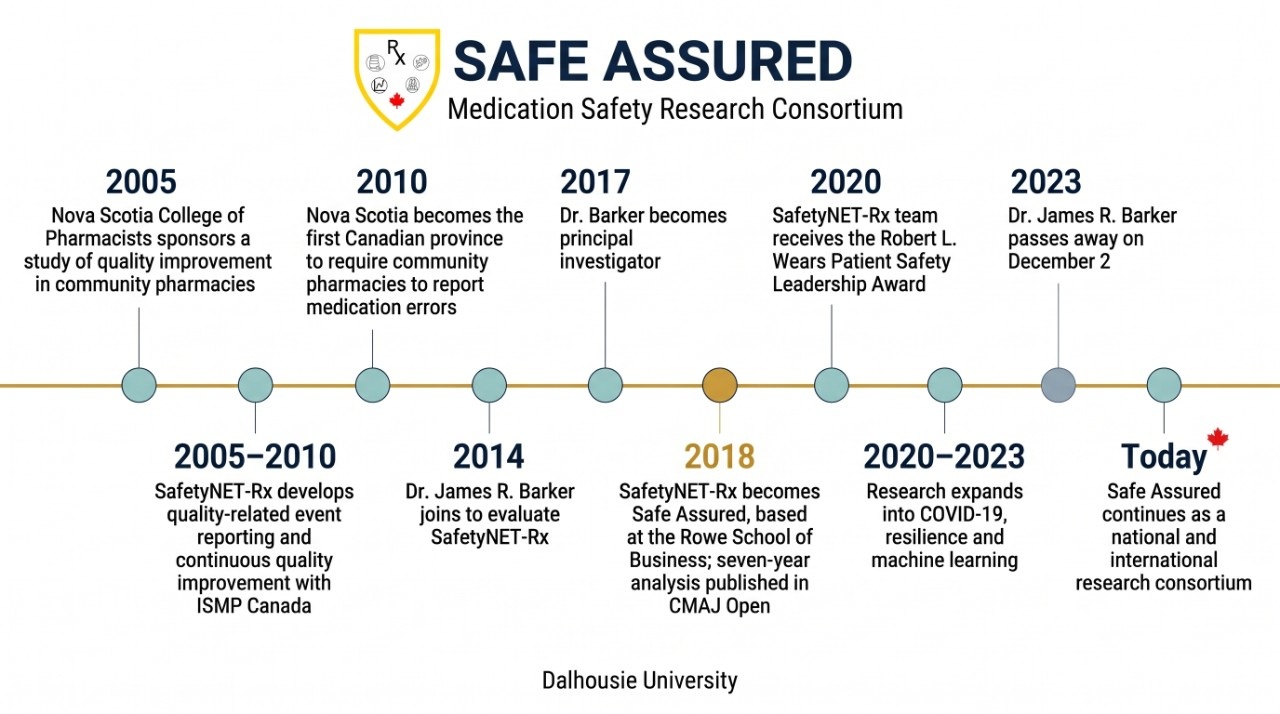
Milestones at a glance
2005
- Nova Scotia College of Pharmacists sponsors a study of quality improvement in community pharmacies
2005–2010
- SafetyNET-Rx develops quality-related event reporting and continuous quality improvement with ISMP Canada
2010
- Nova Scotia becomes the first Canadian province to require community pharmacies to report medication errors
2014
- Dr. James R. Barker joins to evaluate SafetyNET-Rx
2017
- Dr. Barker becomes principal investigator
2018
- SafetyNET-Rx becomes Safe Assured, based at the Rowe School of Business; seven-year analysis published in CMAJ Open
2020
- SafetyNET-Rx team receives the Robert L. Wears Patient Safety Leadership Award
2020–2023
- Research expands into COVID-19, resilience and machine learning
2023
- Dr. James R. Barker dies on December 2
Today
- Safe Assured continues as a national and international research consortium