MacEachen Institute Round Tables
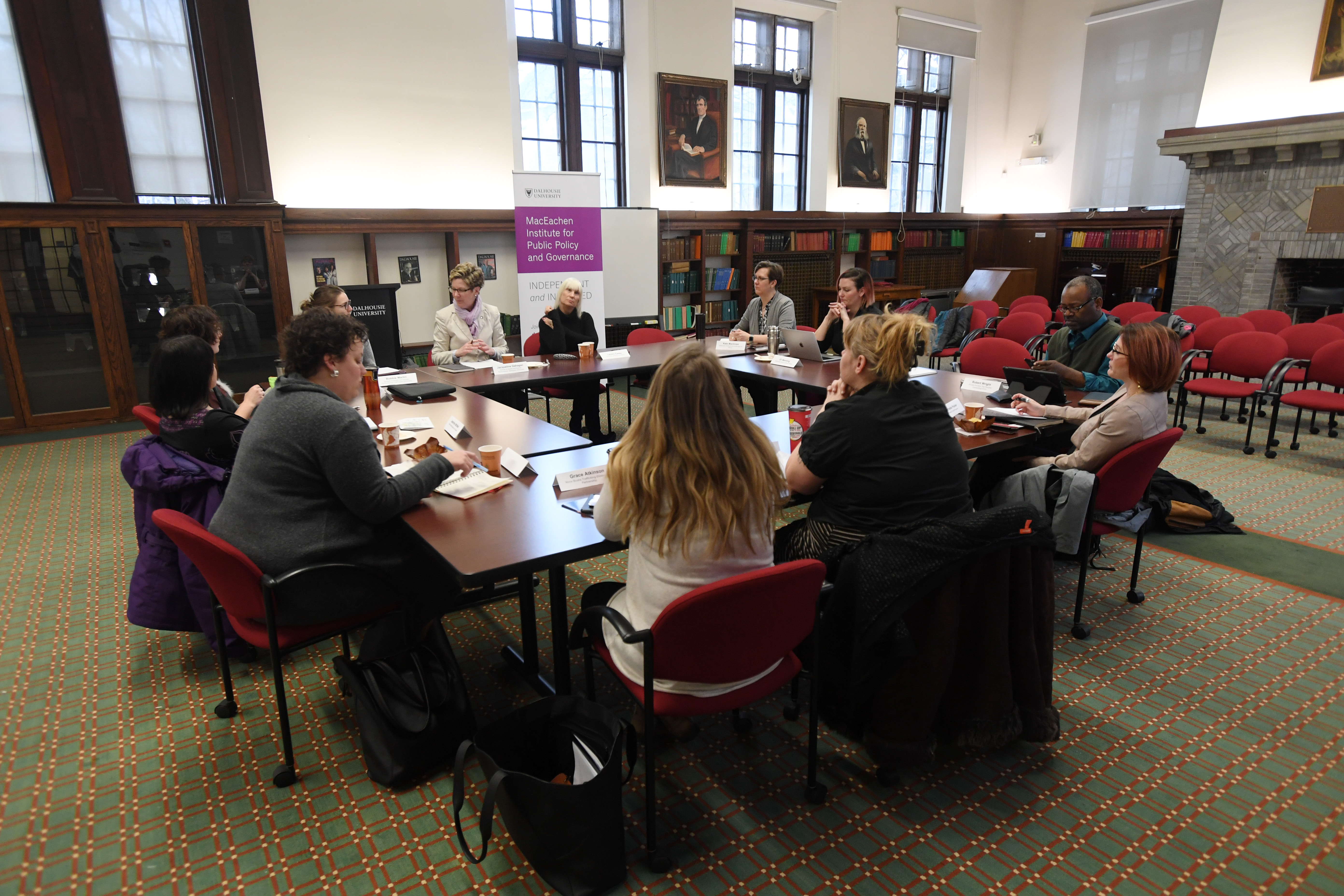
When important public policy decisions are on the horizon, the MacEachen Institute brings together experts and policy makers to discuss strategies and weigh options. By facilitating workshops and conferences, hosting speakers and bringing together interested policy experts, stakeholders, faculty members and students, the Institute builds connections with the community and creates an impact with policy-focused research projects.
Below is a list of recent round tables and workshops hosted by the MacEachen Institute
Round Tables and Workshops
International Labour Mobility, Innovation and Inclusive Economic Growth (June 12, 2018)
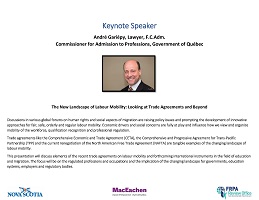 |
Promoting an understanding of the principles of administrative justice, good governance and labour mobility among Nova Scotia regulatory bodies is crucial to the development of fair registration practices and associated accountability mechanisms. The Round Table: An Appraisal of Administrative Law, Good Governance and Labour Mobility, was a closed-door round table session that provided representatives from government, regulatory bodies, employers, post-secondary institutions and representatives from the public sector with an opportunity to view administrative justice as an element of good governance in Nova Scotia through a specialized, labour mobility and fair-access lens. In addition to providing an open forum for discussion around the institutionalization of principles of national and international labour mobility, fairness, transparency, objectivity and impartiality in decision-making, the Round Table resulted in the production of a report that will be posted on the FRPA web application used as a reference for regulators working towards compliance with the Act. |
Round Table on Ports and Shipping in Atlantic Canada (March 28, 2018)
 |
The MacEachen Institute for Public Policy and Governance, in collaboration with the Borders in Globalization Network, will be held a round table discussion on Ports and Shipping in Atlantic Canada on Wednesday March 28th, 2018 at Dalhousie University. The event featured presentations from Michael Ircha (University of New Brunswick and Carleton University) and Jeff Collins (BIG PhD student, Carleton University) who will be speaking about their research related to the broad themes of marine shipping and international trade, border challenges, Canada Port Authorities' duty to consult with First Nations, modernizing and financing port infrastructure, port security and governance, and protecting the marine environment. More information about this round table can be found on Borders in Globalization's website. |
Managing Risks to Water Resources (March 26, 2018)
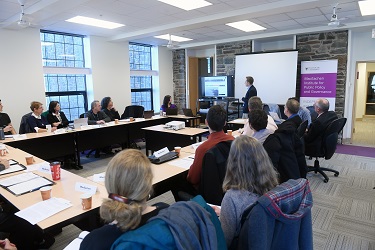 |
The MacEachen Institute for Public Policy and Governance, in collaboration with Nova Scotia Environment and the Centre for Water Resources Studies held a half-day round table discussion focusing on the theme of water, in celebration of World Water Day. Presenters were Barret Kurylyk and Kevin Quigley who spoke about risks and solutions to coastal water resource challenges as well as recent findings from a research study on risk perceptions in the water sector. The round table discussion was held on March 26th, a few days after World Water Day 2018 (celebrated on March 22nd). |
Nowhere to Go: A Round Table on Youth and Sexual Exploitation (March 9, 2018)
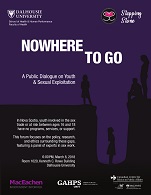 |
Hosted by Stepping Stone, the Canadian Centre for Ethics in Public Affairs, the MacEachen Institute, the Healthy Populations Institute, and the Gender and Health Promotion Studies Unit, a policy round table discussion was held on how Nova Scotia can meet the complex social, legal and public health needs of youth who may be at risk for sexual exploitation and/or trying to exit. This meeting will took place on Friday March 9th at the MacEachen Institute for Public Policy and Governance. |
Communicating Marine Risk with Focus on Coastal Flooding and Forecasting (March 1, 2018)
 |
The communicating marine risk workshop included experts in marine forecasting, risk perception, emergency management, evacuation, and flooding response. Nine of the 24 workshop participants were forecasters and model developers, individuals who work and conduct research in marine forecasting and predicting extreme weather events. They outlined the existing model for predicting extreme weather, spoke to the specific challenges that face the Halifax Peninsula and detailed the potential benefits of using a more accurate ensemble forecasting model for future predictions. Eight of the workshop participants were ‘users’, defined as stakeholders who would need to use forecasting information and/or take action upon receiving news of an approaching extreme weather event. Users included emergency managers, representatives from the Canadian Armed Forces, Halifax Water, the Marine Pilots Association, Public Health Agency of Canada, and Halifax Public Works. |