
News
» Go to news mainBringing Solar Power to a New Surface: A Dalhousie Graduate Returns to Continue What He Started

When Jesús Gonzalez Navidad finished his undergraduate degree in nanotechnology engineering in Mexico, he did what many new graduates do: he went straight into industry. He was working as an automation technician, settling into a routine, thinking about his financial future and his life in Mexico. Then, he received an unexpected email.
It was from his former supervisor, Dalhousie Engineering researcher Dr. Ghada Koleilat. A year after completing a summer research internship at Dal through the Mitacs program, she invited him back to Halifax to continue the project as a master’s student.
“The email really caught me off guard. I didn’t know what to say at first, and it was a tough decision,” he remembers. “But in the end, I felt coming back was the best choice to continue the project and finally try an idea I’d been thinking about for a long time.”
The idea was to take the knowledge and skills he had gained during his internship and use them to make a tangible difference in Mexico, where he says the significant potential of renewable energy remains largely untapped.
Exploring Flexible Solar Technology
Jesús had learned a lot working in Dr. Koleilat’s lab. Her research explores innovative approaches to renewable energy, from solar cell development to flexible, low-cost energy devices. The work explores practical applications and creating technologies that can deliver sustainable energy to communities that need it most.
“After my internship, renewable energy became something I thought about a lot more. It really opened my eyes to the possibilities, especially when I thought about Mexico, where we still rely heavily on fossil fuels and the transition to renewables has been much slower,” he says. “There is so much potential for renewables, especially solar, but we’re not really using it yet.”
Last September, Jesús moved back to Halifax to begin his master’s degree. Since his internship, the project had grown, gaining new funding and partnerships with industry. His focus is on developing flexible solar cells, a technology that could bring renewable energy to places where traditional panels cannot be installed.
Right now, the team is experimenting with upcycled fabric, transforming what would otherwise be waste into a valuable substrate for their cells. One of their key collaborators, Andritz Fabrics and Rolls, provides the recycled material for testing and development.
“The fabric we’re using is reusable and upcycled,” says Jesús. “I love the idea of turning something that’s just fabric into a device that can generate electricity. It’s exciting to think about the real-world applications, what we can actually do with it beyond the traditional rooftop solar panel.”
Testing, Experimenting, Imagining
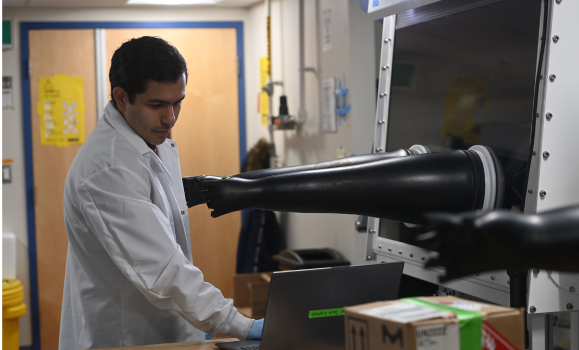
In addition to exploring the fabrics, Jesús is also pushing the limits of the solar cells themselves. The lab recently acquired a new aerosol-based printer that allows the team to test a coating technique for depositing the layers needed to create a solar cell directly onto flexible fabric. Jesús says this opens the door to converting sunlight harvested by the fabric into electrical energy, an approach that wasn’t possible during his internship.
“I’ve been testing it with different chemicals and substrates to see if it’s feasible, if it works, and if it’s conductive,” he explains. “One of the key requirements is that the materials we use have to conduct electricity, so the solar cell can harvest sunlight and convert it into usable energy.”
The work involves a lot of experimentation, a lot of problem-solving and a lot of trial and error.
“I think the most exciting thing about this project is the idea of turning waste into something valuable, like a photovoltaic or electronic device that can generate renewable energy,” he says. “If the energy from the sun that hits the prototype is converted effectively, that’s really exciting. It makes me think about how we could use it in real situations, not just on rooftops. Could we put it on clothing? On machines? Or even on an umbrella, so maybe while you’re at the beach you could charge your phone?”
“One idea is putting them on tractors so they can harvest solar energy while working on the farm,” he adds. “Or maybe on walls or other surfaces where traditional panels wouldn’t fit.”
And how will he take this knowledge back with him to Mexico?
“I’d love to figure that out, to be honest,” he says. “I’ve been talking with my supervisor a little about it, but for now, I’m focused on the project and finishing my thesis. After that, we can start exploring ways to bring this work to Mexico and make it useful there. That’s one of my goals, taking what I’ve learned or developed here and trying to make it work in Mexico.”
Recent News
- Faculty of Engineering’s new Indigenous Pathways Program Coordinator Pays It Forward
- How Two PhD Students Are Powering Nova Scotia’s Tidal Future
- How the Faculty of Engineering’s Annual Golf Tournament Helps Bring Student Ideas to Life
- Meet the Team behind the Jumpsuits: How the Dalhousie Engineering Gearheads are making an impact
- Celebrating 90 years of Dr. Dhandapani Thirumurthi
- From Wind to Sun to Steady Power
- Galaxia Mission Systems co‑ops offer space tech experience
- Bringing the Future of Wireless Power to Halifax