
News
» Go to news mainThe beating heart of research: Capstone students’ research could help save lives of people with cardiac arrhythmia

Creating something that could help humanity may seem like an ambitious goal for an undergraduate project, but that’s exactly what a team of Dalhousie University Electrical Engineering students hopes their capstone project will achieve.
“We took this biomedical project because we're interested in the bridge between electrical systems and the human body,” says Ispeeta Ahmed, “and trying to create something that could help humanity.”
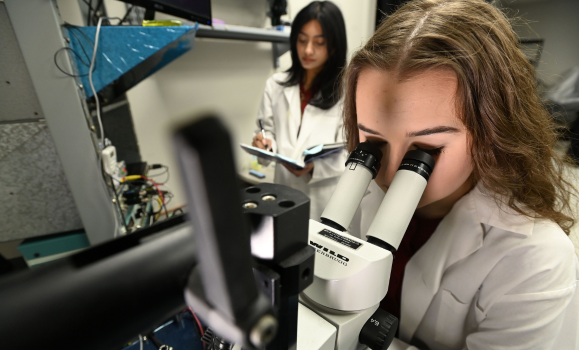
For their Capstone Project — supervised by Professor Sergey Ponomarenko — Ispeeta, Cassie Norman and Orion Wiersma worked in Professor Alex Quinn’s Cardiac Autoregulation and Arrhythmias Laboratory. Their research involved using LED light to stimulate the activity of zebrafish hearts. (Zebrafish hearts are often used in arrhythmia research, because they beat in a way that’s similar to the human heart.)
Ultimately, their findings could help lead to new treatments for a form of cardiac arrhythmia called Long QT Syndrome.
Cassie explains: “Your heart basically is a mechanical pump, but it's electrically driven. So when your heart isn't beating properly, a lot of the times you can trace that down to the level of the electrical signal in the cells in the heart, in order to figure out what’s causing that.”
For people with Long QT Syndrome, those electrical pulses last too long. The Capstone Project, which is called, “LED Feedback System for Optogenetic Control of Cardiac Electrical Activity,” uses light to try and shorten those pulses, but without affecting the shape of the heart as it beats.
New Possibilities
The research is part of a revolutionary new field in neuroscience called optogenetics, which, the Quinn Lab says, “entails the control of cellular activity with genetically-encoded light-activated ion channels and pumps."
“We're basically trying to modulate the light that you have to use in the optogenetics experiment.” Ispeeta says. “So, it's a lot of MATLAB [a programming language], a lot of coding. We're stimulating an actual heart in real time. And then we're creating a controller system that can modulate the heart in real time.”
Numerical modelling was key to the project, creating a computational model that ultimately drives the light to turn on at the correct intensity. That modelling made it possible to move beyond simulation, to a fully functional system where light could be controlled by the algorithm.
If the process works, it could ultimately lead to implantable devices that can save human lives. “We see a genuine pathway for this to be in a medical technology in our lifetimes,” Cassie says.
The Capstone Project provided invaluable skills and opportunities beyond the research itself. “It's taught me a lot about not only the technical work, but also the communication aspects,” Orion says. “Being able to present our work, and to collaborate with peers outside of our department as well. It definitely taught me a lot about that, and I'll probably apply those skills in the future.”
For Ispeeta, the communications aspect was important as well. “Our work is technical, right? So to be able to communicate it in a 15-minute presentation, make sure that everybody understands, and make sure we can answer the questions correctly — I think that's something that's really important in any science career.”
Asked about the most important thing that she got out of the project, Cassie says, “I have a good answer to this, because I was about to graduate in eight months when I started in this lab, and now I'm pretty convinced I'm going to do a master's in this lab, working on this project, because I really, really love it.”
She adds, “It's totally different to take things from the classroom and actually use control theory in real life. There's a learning curve to that, and Capstone does a really great job of making you feel far more confident, going into whatever you may do in the future.”
Recent News
- Faculty of Engineering’s new Indigenous Pathways Program Coordinator Pays It Forward
- How Two PhD Students Are Powering Nova Scotia’s Tidal Future
- How the Faculty of Engineering’s Annual Golf Tournament Helps Bring Student Ideas to Life
- Meet the Team behind the Jumpsuits: How the Dalhousie Engineering Gearheads are making an impact
- Celebrating 90 years of Dr. Dhandapani Thirumurthi
- From Wind to Sun to Steady Power
- Galaxia Mission Systems co‑ops offer space tech experience
- Bringing the Future of Wireless Power to Halifax