

He’s the hero Gotham deserves, not always the one it needs, but certainly the one that filmgoers are clamouring for.
The Dark Knight Rises, the final film in director Christopher Nolan’s acclaimed take on the Batman mythology, comes out this Friday, entering a summer movie season already dominated by superheroes.
But Rises is perhaps the most anticipated of them all, building as it does on two films—Batman Begins and The Dark Knight—that managed to rack up both massive box-office dollars and the sorts of critical raves generally reserved for Oscar contenders. Nolan’s modern, realistic Gotham grounds Batman at the centre of political intrigue and danger, raising questions of power, order and justice that echo the times.
Todd McCallum, assistant professor in Dal’s Department of History, is something of a Batman aficionado; he’s even planning a book on the character’s legacy, titled Boss Bruce Wayne. He says one reason why Nolan’s take on Batman has been so popular is that it taps into the character’s elemental darkness.
“Personally, my take is that we love Batman because he suffers so much,” he explains. “He has dedicated his life to fulfilling a childhood vow made to his dead parents, and he understands everything he does in relation to the progress of his campaign. As Bruce Wayne, his personal relationships are destined to remain superficial and dishonest to the core, sublimated to the larger goal of eliminating crime, especially those involving violence.”
A vigilante through the ages
That said, we haven’t always loved Batman. In fact, DC Comics contemplated cancelling the franchise in the 1960s because of lagging sales compared to those of the Superman family of characters. And while the campy 60s live-action television series introduced a new generation to the Caped Crusader, its tone was decidedly at odds with the character’s origins, and it took until Tim Burton’s 1989 film for Batman to return to the screen.
In the comics, Batman has had his share of evolutions. He first appeared in Detective Comics in 1939, and was created by artist Bob Kane and writer Bill Finger. He was a violent vigilante: using a gun, letting criminals die, and Bruce Wayne’s playboy antics were dialed way up. You could even say that the character was a bit of a one percenter, focused on recovering missing jewels and other treasures of Gotham’s elite. But soon, the character was refocused on more populist, patriotic ends, though never quite to the degree of his counterpart, Superman.
“At the end of the Great Depression, a time that most historians believe represented the peak of leftist activism in America, Bruce Wayne—the embodiment of the idle rich man who profited from the labour of others but did no useful work himself— becomes a 'Caped Crusader,'” says Dr. McCallum. “It’s a variant of the American Dream: that the louche playboy is really a hero, who spends his wealth not on conspicuous consumption but fighting criminal gangs and aiding the citizenry.”
Over the years, the character has flirted with science fiction and psychedelica. He’s had many sidekicks, including various Robins and Batgirls. There’s been alternative or imaginary stories, including a Batman who fights vampires and werewolves in Victorian Gotham and a libertarian Batman fighting a futuristic totalitarian state. In the 1970s and 80s, the character was modernized, and iconic arcs by writers such as Steve Englehart and Frank Miller told stories that were darker, more adult, and highly influential on Nolan’s take on the character. Miller's The Dark Knight Returns seems particularly relevant to The Dark Knight Rises, dealing as it does with an aging Bruce Wayne who returns to the Batsuit after a long hiatus.
Bane: Batman’s physical threat
Nolan’s first two Dark Knight films relied on classic villains from Batman’s rogues gallery: The Joker, Two-Face, and The Scarecrow all date back to the 1940s, whereas Batman Begins’ Ra’s Al Ghul first appeared in the 1970s, a stereotypical Arab articulating America’s rising fears of the Middle East.
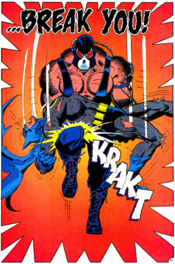 The Dark Knight Rises adds another classic character in Catwoman, but its primary villain is a far more recent creation. The monstrous Bane first appeared in the comics in the early 1990s, with physical capabilities scientifically engineered by a chemical called “venom.” In the famous Knightfall story arc, Bane breaks Batman’s back, crippling him (see left). This leads to Bruce Wayne being replaced as Batman by a character named Azrael, though eventually Wayne returns to the post.
The fact that Bane sounds like Bain Capital—presidential candidate Mitt Romney’s former firm—has even generated halfway-serious speculation that the movie might influence the American election.
“Rush Limbaugh has weighed in on it, so you know it must be an important issue!” says Dr. McCallum, with a laugh. “Anyway, the funny thing about this for me lays in the fact that writer Chuck Dixon, co-creator of Bane with artist Graham Nolan, is one of the most conservative comic-book writers out there.”
Dr. McCallum’s favourite of Nolan’s two films thus far is The Dark Knight, to which he largely credits the performances of Heath Ledger as the Joker and Aaron Eckhart as Harvey Dent/Two-Face. He’s intrigued to see how Nolan wraps up the series, and says it’s fitting that Nolan’s superhero francise feels darker and deeper than most of its contemporaries.
“Unlike [fellow DC characters] Superman, Green Lantern and Wonder Woman, Batman represents both human suffering and the equally human attempt to bring about its end.”