
 |
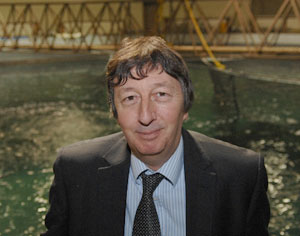
| Dal's newest chairholder: Douglas Wallace, CERC in Ocean Science and Technology. (Danny Abriel Photo) |
From the spectacular view of the Northwest Arm to the more than 100 faculty across campus involved in marine research, Dalhousie has a special relationship with the ocean. That relationship is about to be taken to the next level with a groundbreaking new research chair.
On Monday, the Government of Canada awarded Dalhousie a new Canada Excellence Research Chair (CERC) in Ocean Science and Technology, bringing renowned chemical oceanographer Douglas Wallace to the university to lead a multidisciplinary team of oceans researchers.
“This is truly an exciting day for Dalhousie and the whole Atlantic Region,” said Scott Armstrong, Member of Parliament for Cumberland-Colchester-Musquodoboit Valley, who made the announcement at an event in the Milligan Room of the Life Sciences Centre.
The chair, one of 19 CERCs awarded across Canada, will receive $10 million over seven years from the Government of Canada to support its research into how CO2 and other greenhouse gases are exchanged between the ocean and the atmosphere. Dalhousie will match that with a further $24 million to put together a CERC Research Unit, consisting of seven new hires and several researchers at Dalhousie presently engaged in work related to the CERC focus. Between researchers, post-docs, students and support, the chair will add over 40 positions to the university’s research capacity.
“As we welcome Dr. Wallace to Dalhousie, we are also welcoming a new team of oceans researchers,” said President Tom Traves, thanking the CERC program for making the chair possible. “I think it’s a tremendously far-sighted initiative on the part of the Government of Canada.”
Dr. Wallace, who comes to Dalhousie from the Leibniz Institute of Marine Sciences and the University of Kiel in Germany, plans to study the rapid changes in the North Atlantic as a result of human intervention.
“Many of the changes going on in the ocean are human influenced,” he said. “The recent disaster in the Gulf is just the latest example. These pressures are now global and growing deeper and deeper...what happens in a very distant part of the ocean -- or atmosphere, for that matter -- can affect Canada very directly.”
It’s a sort of homecoming for Dr. Wallace, who graduated from Dalhousie with his PhD in 1985. Julie LaRoche, his wife, also earned her PhD from Dalhousie; the two met while studying in Halifax. A marine microbiologist, she will be joining her husband at Dalhousie as part of the CERC Research Unit.
The process of earning the chair was an intense one -- a multi-stage proposal process that required a cross-departmental team led by Keith Thompson, professor with the Departments of Mathematics & Statistics and Oceanography.
“This was really made possible by a spirit of teamwork across departments and disciplines and between faculty and administration,” said Dr. Wallace. He noted that having pulled together to earn the funding in a competitive process, now it was up to the university and his new research team to deliver on the promise of their research.
“Now it’s up to me to show that you made the right choice.”
Comments
comments powered by Disqus