
 |
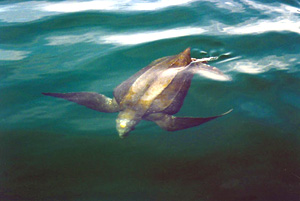
| (Photo courtesy Canadian Sea Turtle Network) |
They survived the extinction of the dinosaurs. They're descendants of one of the oldest family trees in history, spanning 100 million years. But today leatherback turtles, the most widely distributed reptiles on Earth, are threatened with extinction themselves, in large part due to the carelessness of humans.
We've seen reference to the dangers plastic poses to marine life, garbage that we humans directly and indirectly deposit in the oceans, but how clearly have we received the message? Not well enough according to a recent article in the journal Marine Pollution Bulletin entitled “Leatherback turtles: The menace of plastic,” co-authored by Dalhousie's Mike James.
“We wanted to see if plastics ingestion in leatherbacks was hype or reality,” says Dr. James, senior species at risk biologist for Fisheries and Oceans Canada and adjunct professor with Dalhousie’s Department of Biology.
“It was a monumental effort that looked back at necropsies over the last century from all over the world,” he explains. (Necropsies are post-mortem examinations performed on animals.) “After reviewing the results of 371 necropsies since 1968, we discovered over one third of the turtles had ingested plastic.”
Since leatherbacks prefer eating jellyfish, it's widely believed they mistake bags or other plastics for their meals. Since jellyfish and marine debris concentrate where ocean water masses meet, leatherbacks feeding in these areas are vulnerable to ingesting plastic.
Once leatherbacks ingest plastic, thousands of spines lining the throat and esophagus make it nearly impossible to regurgitate. The plastic can lead to partial or even complete obstruction of the gastrointestinal tract, resulting in decreased digestive efficiency, energetic and reproductive costs and, for some, starvation.
“Plastics ingestion doesn’t always cause death, but there are clearly health risks to the turtles,” says Dr.James.
Fascinated by reptiles as a child, Dr. James developed a lifelong interest in turtles, from raising them as a kid, to his PhD research and now as a biologist and conservationist. He says there are simple ways to stop these ongoing threats.
“The frustrating, yet hopeful aspect is that humans can easily begin addressing the solution, without major lifestyle changes,” says Dr. James. “It's as simple as reducing packaging and moving towards alternative, biodegradable materials and recycling.”
Leatherback turtles are classified as critically endangered world-wide. The true population size is not precisely known, as only adult females come ashore for nesting in remote tropical locations. During the summer and fall, Canadian waters support the highest density of foraging leatherbacks in the North Atlantic.