
Changing the conversation

Panel shares their thoughts on our sustainable future

by Ryan McNutt - March 20, 2009

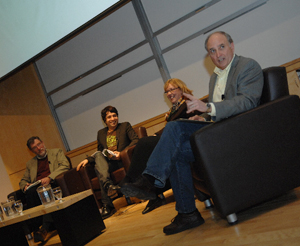
The panelists discuss the dangers of climate inaction. Left to right: Jeff Moore, Jian Ghomeshi, Elizabeth May and David Orr (Danny Abriel photo)

It began with harrowing questions about the future of our planet. It ended with a joyous sing-a-long that had the capacity crowd on its feet.

That last night’s Dialogue for Change panel made such a transition does not mean that the world’s problems were solved in its two hours, or that the audience’s concerns about global climate change and environmental sustainability were all erased. Still, there was something truly inspiring about seeing such a diverse panel of environmental leaders share their thoughts on where our society has gone wrong and where it needs to go next.

“I thought we were done with ‘change’ with Obama,” said Jian Ghomeshi, opening the evening with a laugh. “Clearly, he lied to us.”

Seated in the middle of a semi-circle of chairs at the front of the Ondaatje Auditorium, the host of CBC’s “Q” led the panelists through a series of provocative questions that saw them challenge the political and economic status quo and address a larger, fundamental question: who, or what, will enable us to become a more sustainable society?

“The ‘who’ is rather easy – it’s us” answered Jeff Moore, founder of Just Us! Coffee Roasters Cooperative. “Or, if you will, ‘just us.’ We really can’t afford to wait for anyone else to do it.”

If the audience was left with a single theme for the evening, it may have been urgency. All four panelists argued the need for immediacy in tackling problems such as global climate change, perhaps none as passionately as Green Party leader Elizabeth May. “When we say we’re running out of time, I mean December 2009,” she said, referring to the forthcoming United Nations climate change conference in Copenhagen.

Ms. May saved her harshest words for Canada’s current federal leadership. “[The Americans] have Obama, and we still have George Bush,” she said to applause. “Until we see a change in political will, we won’t be able to make these broader changes.”

David Orr may have been the most unfamiliar of the four participants to many in the audience, but the global expert in sustainability education provided several of the discussion’s most valuable insights. “We know better than we act,” he said, explaining that the real crisis of sustainability is the need to inspire genuine political and social change, not just a “greenwashing” of the issues.

In one of the evening’s most passionate discussions, all four panelists rejected fatalist views that the state of the earth is too far gone to make it worth changing course. “There’s just as much hubris in saying that we’re too late as in saying it’s not a problem,” said Dr. Orr. “Optimism and pessimism both ask us to do nothing. But not hope – hope is a verb with its sleeves rolled up. You don’t know if you’re going to win, but you’re willing to labour after it.”
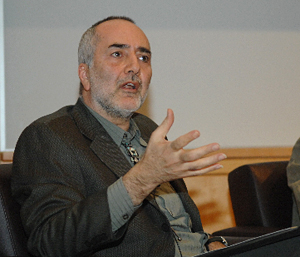
Singer/songwriter Raffi Cavoukian (Danny Abriel photo)

That each of these panelists largely focused on their own field when discussing possibilities for change – Ms. May and politics, Mr. Moore and business, Dr. Orr and social thought – is perhaps not surprising. But anyone who turned up expecting singer/songwriter Raffi Cavoukian to break into “Baby Beluga” were almost certainly impressed by his passion for the world that will be passed down to future generations.

Defining sustainability as “a code of conduct for how we need to live together,” the global troubadour explained how a philosophy of child-honouring needs to link future generations more closely with the planet: “We’re talking here about the theft of futures…it’s a fundamental human rights issue.” He, like the others, emphasized the enormity of the challenge ahead: “It’s not incremental change that we need – it’s systematic change.”

And since Mr. Cavoukian argued pessimism is “a luxury that we can’t afford,” it's only fitting that the evening’s conclusion was also the event's emotional highpoint. "Raffi Cavoukian the Activist" transformed into "Raffi the Performer" as he took to his feet and sang along to his brand new song, “SustainABILITY.” With a reggae beat behind him and a childish swagger in his toes, he pulled each of his fellow panelists to their feet to sing about “kindness & compassion…restoring every nation.”

The tune was catchy, sure, but judging by the number of attendees who stuck around the lobby to chat after the panel was over, last night’s ideas may have been every bit as memorable.

The Dialogue for Change panel was sponsored by Dalhousie' College of Sustainability.

SustainABILITY: Raffi performs the world premiere of his new song at Dialogue for Change. Watch the video

Readers Say

The panel has certainly inspired me to do more than I am doing at the moment and especially Raffi Cavoukian has given me some specific ideas to try to educate our young more and better, implement the change in them and Ms. May and the other panelist have given me more reason to continue to write to our political leaders, MP's, MLA's to demand real change and action now and to talk to friends and family to hopefully inspire them to join and act.
I am very glad that I attended last nights discussion.
I am very disappointed I'm not in Halifax and had to miss this.
My dad has been involved in one way or another in the mining industry in NS for over 30 yrs...and unfortunately it is because of persons like Ms May who have made this once thriving industry to what it is today. She and others like AL "The Goreacle" Gore who go around tongue flapping from one coffe house to another trying to justify their very existence here on God's green earth. My question is how does Ms May plan to get to Copenhagen in December? by all means you can borrow my Sea Necky and Garmin! and really go Green!
By the way Americans do not have Obama...you are relying to much on your tea leaves if you think that Obama doesn't have a hidden agenda. Obama is doing to America what Trudeau (dirty old man) did to Canada in the 60's.
Mr. Thomson's comments are very discouraging, but they point to the greatest problem of sustainability and climate change. What will it take for the public to understand that things can not be "business as usual" if we want our children and grandchildren to inherit a habitable world?
I attended this panel discussion(?) and must admit that I was disappointed. Even though the panelists were intelligent, well spoken people, they were all singing from the same songsheet. Face it, this was not a panel discussion, it was a rally. If htere had been a couple of panelists with divergent viewpoints than those of the 4 panelists present, ut would have made the evening much more valuable and insightful.
I also attended this discussion, and feel the need to remind that it was a 'discussion', and not a 'debate'. The panelists all had four very different backgrounds and set of life experiences, and very different ideas of what ways are most effective to change the systems in which we work. Whether it be academics (Orr), art (Raffi), politics (May) or business (Moore), the discussion pointed to the various routes though which the process of sustainability is attainable.

Kudos to all that organized the wonderful event.
An electrifying event. While Gord Arthur is correct in observing that the evening carried some elements of a rally, I don't think this was a negative thing for most. The crowd engaged with and was supportive of the panelists. Personally, I left encouraged and inspired.

Highlights included Raffi Cavoukains thoughts on child honouring as a philosophy and component of a sustainable future. Elizabeth May also did an excellent job calling for awareness and action in regards to the upcoming climate change summit in Coppenhagen this Decemeber.
An electrifying event. While Gord Arthur is correct in observing that the evening carried some elements of a rally, I don't think this was a negative thing for most. The crowd engaged with and was supportive of the panelists. Personally, I left encouraged and inspired.

Highlights included Raffi Cavoukains thoughts on child honouring as a philosophy and component of a sustainable future. Elizabeth May also did an excellent job calling for awareness and action in regards to the upcoming climate change summit in Coppenhagen this Decemeber.
Divergent viewpoints? What would that look like? This was a discussion about how we get to a sustainable future NOT whether a sustainable future is a good thing or not OR whether we need to talk about environment and sustainability issues. We do! Of course all of the panelists are going to have some similar thoughts, but I thought they had lots of different ideas on how we can become more sustainable. This panel started the dialogue - now it's up to us to continue it.
I was impressed by the inspired insight from Elizabeth May and David Orr (minus his politically incorrect analogy between an unsustainable future and pro-choice abortion). Although I am a big fan of Raffi's music, I feel that "Raffi Cavoukian the Activist" could not hold his own among greats like Ms. May and Dr. Orr. Elizabeth May's goal to highlight the embarrassment that is the Harper government was effective and I especially appreciated her regard for scientific information, in contrast to Raffi's unrealistic optimism.
I think Raffi raised some very important issues. We're always talking about what we need to do to get sustainable. Well we need to do a better job including children in the discussion. If we aren't proactively and constantly educating our youth about the importance of sustainability then each generation will be in the same place we are. They need to be educated and empowered. Our contribution not only has to be providing a better place for youth, but to include them in the solutions.
To Ms. Caron, call it discussion or debate I don't care, but if one wants to see a well rounded treatment of a particular issue, you don't listen to only arguments coming from one side. If you threw a bunch of Catholics into a room to discuss how future world-wide religions should proceed, do you not think biased conclusions would result? You say how we implement a sustainable future was at the core of the discussion and not whether or not, or to what degree, global warming will affect us in the future. Even if I grand you that point, you will have to admit that there are viewpoints widely divergent for those of the 4 panelists. Why were none of these represented? In your opinion these 4 were coming from different fields but I would disagree very strongly.

Join the conversation, but keep it clean, stay on the topic and be brief. Read comments policy.

Characters remaining: 2000

(optional)