
Is a hands-free phone safer?

By Marilyn Smulders - July 3, 2008

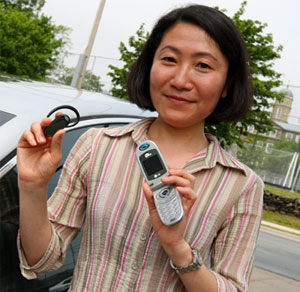
Dalhousie PhD student Yoko Ishigami asks "Is a hands-free phone safer than a hand-held phone?" (Nick Pearce Photo)

Since April 1 when Nova Scotia outlawed the use of hand-held cellphones while driving, sales of hands-free devices have gone through the roof. It seems everyone’s driving—even walking—with tiny electronic devices tucked into their ears.

Conventional wisdom says they’re safer. With wireless technology such as Bluetooth becoming commonplace, you can still conduct business, order pizza or talk to mom while keeping both hands on the wheel.

But is the mind on the road? A Dalhousie PhD student in experimental psychology says hands-free cellphones are not safer and indeed may even be more dangerous than hand-held.

Killam scholar Yoko Ishigami presented her paper, “Is a hands-free phone safer than a hand-held phone?” at the national conference of the Canadian Association of Road Safety Professionals held last month in Whistler, B.C. She was awarded first place in a national student paper competition.

“Talking and listening are such complicated tasks, especially if you’re thinking ahead to what you’re going to say,” says Ms. Ishigami, an international student from Shizuoka, Japan. “The conversation is what takes all your attention.”

She surveyed current scientific research on cellphone use, showing that talking on the phone, regardless of phone type, has negative impacts on performance, especially when the driver is confronted by complex or unpredictable situations. Performance while using a hands-free phone was rarely found to be better than that using a hand-held phone.

Some studies found drivers compensate for the harmful effects of cellphone use when using a hand-held phone—by driving slower or pulling over to finish a call—but neglect to do so when using a hands-free phone.

“People tend to be overconfident with hands-free and drive faster. They’re thinking, ‘I’m OK because I’ve got on the headgear,” she explains. “Whereas if they were driving with a hand-held phone, they tend to drive slower.”

Ms. Ishigami says the topic of cellphone use while driving has interested her since she was an undergraduate psychology student at the University of Victoria. She recalls being at a pedestrian crosswalk ready to cross the road as a car approached. Locking eyes with the driver, she proceeded across, but had to jump back to curb when she realized the driver wasn’t going to stop. The driver, who was holding up a phone to her ear, didn’t even see her.

“When you’re talking on the phone, your attention is on the conversation. You may be looking at things but that doesn’t mean you’re processing that information.”

One Canadian study Ms. Ishigami reviewed demonstrated that talking on a cellphone while driving increased the risk of an accident four-fold, and that whether the phone was hand held or hands free made no difference to the risk. Considering all the research, she concludes all cellphone use while driving should be banned.

So far, Newfoundland and Labrador, Quebec and Nova Scotia in Canada, and California, Connecticut, New Jersey, New York and Washington in United States have banned hand-held cellphones while driving. India may be the only country in the world which bans both hand-held and hands-free phones while driving.

In Nova Scotia, penalties, including court costs, are just under $165 for a first offence. In Newfoundland and Labrador, the first province to enact a cellphone law in 2003, fines can be as high as $400, plus demerit points. Ontario is considering similar legislation to stop drivers from using cellphones and BlackBerrys while behind the wheel.

“I think what’s troubling is that hands-free devices are rarely banned, and indeed even encouraged,” says Ms. Ishigami.

Dalhouse psychology professor Raymond Klein hopes legislators will pay attention to Ms. Ishigami’s research.

“No one should be surprised that driving while talking on a cellphone is dangerous. But finding that this danger is not much reduced, or reduced at all, by using a hands-free phone is news,” says Dr. Klein. “It is correct but incomplete to think ‘we drive with our hands’ and therefore using them for another activity (dialing, eating, etcetera) might be unsafe. We drive with our minds too … and it’s essential that our attention is devoted entirely to the task of driving.”

TAKE THE TEST: Awareness test

Readers Say

Congratulations Yoko! Great story.
Firstly, I'd like to congratulate Yoko Ishigami for her interesting research and accomplished writing. For a driver, whether or not talking on a hands-free phone is much safer, if at all, to talking on a hand-held phone is very important to consider.

However, if we conclude that there is no difference, or only small difference, the main question of this research is then: - What are the major factors that make talking on electronic devices unsafe for driving?

If the answer is as suggested by Ms. Ishigami:
- “Talking and listening are such complicated tasks, especially if you’re thinking ahead to what you’re going to say,” “The conversation is what takes all your attention.”
Or Dr. Klein:
- “It is correct but incomplete to think ‘we drive with our hands’ and therefore using them for another activity (dialing, eating, etcetera) might be unsafe. We drive with our minds too … and it’s essential that our attention is devoted entirely to the task of driving.”

Then we must ask ourselves, should spoken conversation on the part of the driver, whether that be with passengers in the vehicle, or people on the other end of phone lines, be allowed at all? Should this be unlawful too? What is the difference?

Thoughts?
So true..... but it's a start.......
The difference between talking to someone in the vehicle as opposed to someone on the phone is that the other passenger can also see what is going on around you. Next time you are in the car, observe and you will see that the conversation naturally pauses when more complicated situations arise. It's just natural. Of course, if you are having a heated debate while driving, you will also see driver error rise. We all need to pay more attention to the road when we drive.
My personal experience would tell me that having a hands-free set might not be safer because there are often many people who are not prepared to answer a call with their hands-free set while driving. Therefore, when they are driving and an incoming call occur, they will scramble through their belongings looking for the hands-free set. The diverge of attention at that point often cause many accidents.
Talking on the phone may be a contributer to more accidents by 4-fold. I wonder how much texting/using a wireless device that allows you to access the internet while driving increases the risk? From personal experience I had a friend who would drive while texting on his blackberry device, and multiple times I would ask him if i could take the wheel instead because his driving would be deplorable. However when he was not using his blackberry his driving performance was better.

Since there is no difference between hand held and handless wireless devices while driving a car, and text messaging and wireless internet still increases danger on the road, why doesn't the government just ban all wireless devices from being used in the car period!?

I agree with Yoko in this case, and I commend her for a good job.
Even more dangerous than talking on the phone is changing a CD or eating ("Analysis of the literature: The use of mobile phones while driving". Vagverket: 2007). So why is everyone picking on cell phones?
I understand that there can be a certain level of an "every little bit helps" mentality here, but there are bigger fish to fry. First, if we want safer roads, let’s ban cars that can drive at speeds that exceed all speed limits. That means that we only have cars that can drive about 150 km/h (allowing some room for speeding up to avoid an accident).
While we’re at it, lets ban everything that makes driving dangerous.
Let's ban music in the car
Let's ban bill-boards which distract drivers.
Lets ban good looking girls from wearing short skirts in public – I know they distract me (just used as an example - I don't want this to happen!)

I mean, if its unsafe to have a conversation with my mom about when I’m going to be home for dinner, its certainly unsafe for me to head-bang to Bohemian Rhapsody, looking at a giant sexy girl in a bikini with flashing lights behind her on a billboard, and whistling at the sexy girl in a mini-skirt.

I think you can see where I’m going with this.
The sad part is that we need to ban phones or anything else, drivers ought have the maturity and discipline to stay focused on the critical task of controlling a high speed massive object. If the only victim was the person in question it would be fine, unfortunately when it comes to vehicle accidents there are often bystanders involved.

Until the majority of the offenders are capable of demonstrating the self-restraint necessary I have to agree that banning the use of any wireless device while operating a vehicle would be a good start.

Join the conversation, but keep it clean, stay on the topic and be brief. Read comments policy.

Characters remaining: 2000

(optional)