
| ||
| ||
|
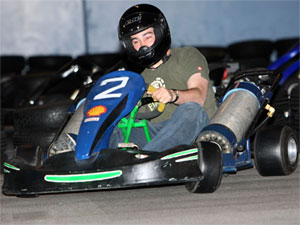
That scenario may sound futuristic, but it may not be long before we see air-powered engines take to the track. Five Dalhousie mechanical engineering students have already started the journey down that road.
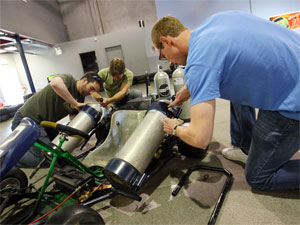
David Alderson, Scott Allan, David Langille, Michael Roy and Dave Spencer were inspired by air-powered car concepts in Europe and decided to develop a compressed air engine of their own for their year-long research project.
“We had done a lot of reading about renewable energy and became really interested in the air-powered car,” says Mr. Langille.
The project, funded through Shell’s Campus Ambassadors Sponsorship program, required them to start from scratch. “The class was comprised of two parts, the first semester was the design semester and the second was for build time and tweaking the design,” he says.
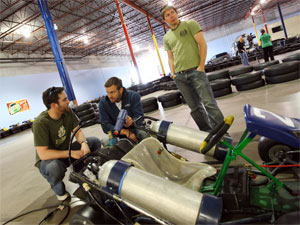
The students modified a 40-year-old snowmobile engine and ran compressed air through the engine to produce power similar to a gas engine. They attached the engine to a refurbished go-kart using two scuba tanks to house the air. The air is released through a standard scuba fitting with a high-flow regulator. The released air travels through tubing to a ball-valve connected to the foot pedal and throttle. “It operates much like a normal rotary engine,” says Mr. Langille.
With the rising cost of fuel, this development is timely in the search for sustainable energy. “Last time we checked there wasn’t a 12 per cent increase in air scheduled anytime soon,” he notes.
While producing zero local emissions is a good thing, Mr. Langille adds a generator is still required to get the compressed air in the tank, but that’s something he hopes can be researched to a greater extent.
The students officially unveiled their air-powered go-kart at Kartbahn Racing in Bayer’s Lake Business Park last week and invited members of the media to take it for a spin. The air-powered vehicle performed comparatively to the electric-powered carts in use. “We can do three laps here or just under two minutes going full out at 43 km/h with two tanks,” Mr. Langille explains.
Kartbahn owner Lucas Strackerjan, who graduated from Dalhousie in 2000 with a Bachelor of Engineering (Mechanical) and a Bachelor of Science in Physics, was impressed with the finished product.
“As someone involved in not only go-kart racing, but the international racing industry, it’s important to find something that’s more advanced and could be accepted as sustainable energy,” says Mr. Strackerjan. “We set benchmarks for the electric cars and the air-powered car went right between them.”
The greatest drawback to the air-powered engine is that it runs out of air quickly. However, Mr. Strackerjan believes the engine will improve with refinements and could be a successor to conventional gas-powered engines.
“Sometimes you gain on one end and lose on the other,” he says. “You have the same issue with gas versus electric, but life is a series of compromises,” he explains.
 |
| SEE VIDEO: Air-powered drive. |
Mr. Langille and his four colleagues are thrilled with their project. “It was an awesome experience, very fulfilling. We’re excited to see it work so well because there were a lot of people who were doubtful and it was exciting to get an A+.”
Mr. Langille says he sees initial practical uses in forklifts and smaller indoor machines. “The zero local emissions make it attractive for indoor operations and the tanks are easy to refill.”
Mr. Strackerjan thinks the project is exciting for the automotive and racing world, as well as Dalhousie. “It’s very exciting this happened at Dal by Dal students,” he says. “When I did my final year project, we made a Baja (for desert racing), which was not very efficient. For them to be doing something like this just seven years later says a lot about the university and the way our ideals have shifted,” he explains.
The compressed air-powered engine and projects from other students can be seen at the mechanical engineering website.
Comments
comments powered by Disqus